
The Forgotten Island Where 97% of Japan’s Defenders Vanished Into History — A Place Not Found on Tourist Maps, Not Saipan, Not Tinian, But a Remote Outpost That Changed Every Life It Touched
When historians discuss the Pacific conflict, the same island names echo through textbooks and documentaries: Saipan, Tinian, Iwo, Okinawa. Yet there exists another island—small, wind-battered, unnamed on most maps—where an entire garrison simply disappeared into time, their presence remembered only through fragments, scattered journals, and the testimony of one unexpected survivor.
This island, known to a handful of scholars as Kibori, sits so far off the traditional routes that even experienced navigators overlook it. It is not glamorous, not tropical, not beautiful in the postcard sense. Its cliffs rise like broken rib bones from the sea, its beaches are narrow strips of crushed coral, and its trees bend permanently toward the west, leaning against the relentless seasonal winds.
It was here, not on the famous islands of larger battles, that 97% of a Japanese defensive force faded into memory—without dramatic headlines, without monuments, without a single clear explanation of how their final days unfolded.
Only one man ever returned to tell the story.
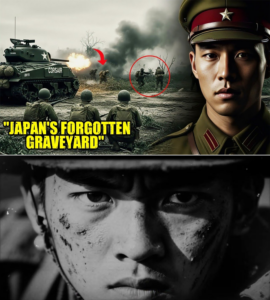
His name was Lieutenant Taro Ishikawa, though by the time he came home, he hardly recognized himself anymore. The year was 1947—long after the official fighting had ended—when a fishing vessel found him on a sandbar near Okinawa, sunburned, exhausted, clutching a wooden box as if it were the last living thing in the world.
Inside the box were journals.
Not his own.
But those of dozens of men who had served with him.
Their voices—preserved in ink—became the only record of what happened on Kibori.
And this is the story he finally told.
Taro Ishikawa was twenty-two when he first saw Kibori.
His unit was assigned to the island during the later stages of the conflict, when attention was elsewhere and the larger strategic map shifted by the month. At the time of their arrival, Kibori was little more than a footnote—an outpost with a tiny harbor, a handful of weather-beaten structures, and a defensive position considered “unlikely to be needed,” according to one officer’s briefing.
But the sea had other plans.
Days after their arrival, a storm—one of the rare, powerful types that can rewrite coastlines—swept across the region. Supply ships were forced to divert. Communication lines flickered and faded. When the skies finally cleared, the island felt adrift from the world, as though it had slipped into a pocket of time that belonged only to itself.
“We didn’t know how isolated we were,” Taro would later say. “Not at first. We assumed the quiet meant we were safe.”
The quiet turned out to be something else entirely.
Life on Kibori took on a strange rhythm.
The soldiers built routines to anchor their days: morning inspections, coastline patrols, clearing debris from the storm, ration distribution, and listening to the static-filled radio that promised news but rarely delivered any.
The men learned the terrain intimately. They knew the cliffside paths where seabirds nested, the freshwater spring that tasted faintly of mineral-rich earth, and the best places to watch the sunset—a moment of color that became their nightly reminder that the world beyond the horizon still existed.
As weeks passed, the radio crackled less frequently. When it did, the voices sounded far away, almost ghostly. One message carried news of shifting fronts. Another mentioned the possibility of peace talks. Then one night, the radio fell silent entirely.
Not broken.
Not damaged.
Simply silent.
“Like a door closing,” one soldier wrote in his journal.
And that was when the isolation began to sink in—not as fear, but as a strange weight pressing on them from the edges of the world.
The garrison numbered around 300.
Fishermen recruited recently. Career soldiers who had served for years. A medic who had once dreamed of being a painter. A cook who wrote poems on ration wrappers. Young men who missed their families. Older men who rarely spoke.
In normal conditions, such diversity might have caused friction. But Kibori worked differently. The island’s solitude seemed to press the men into unity, like clay shaped by invisible hands.
“We became something like a family,” Taro recalled. “Not a perfect one. But a family forged by circumstance.”
They played cards beneath lantern light. They took turns telling stories about their hometowns. They repaired fishing nets and cast lines into the calm morning sea. When supply ships failed to arrive, they rationed carefully, even creatively, turning dried seaweed into soups and stretching every grain of rice like gold.
They waited for news.
And waited.
And waited.
But the world did not return.
The turning point came in late autumn.
A reconnaissance plane—unmarked, unfamiliar—passed high overhead. The soldiers looked up, shading their eyes. The plane did not descend. It did not send signals. It simply flew by, trailing a thin line of white cloud.
From that moment, the men realized the truth:
Kibori had been forgotten.
Not intentionally.
Not maliciously.
But simply… overlooked.
On larger islands, battles raged. On others, negotiations advanced. But Kibori—tiny, wind-scoured, strategically insignificant—had slipped into the blind spot of history.
“We are not lost,” one sergeant wrote in his journal. “The world has simply moved on without us.”
Those eleven words captured the heart of their experience.
Winter changed everything.
The winds strengthened. The air sharpened. The sea grew restless. Fishing became treacherous. The crops planted near the fresh spring withered. Lantern oil became precious. Some nights, the men huddled together in the old warehouse, sharing body warmth as if trying to preserve the idea of home.
But what struck Taro most during this time was not despair—it was resilience.
“We can endure,” the medic said, handing out herbal teas brewed from island plants.
“We will rebuild the spring wall,” another promised.
“We will fish again when the sea calms,” a third added.
Even in hardship, the men found purpose.
Yet the winter storms took their toll.
Men weakened from limited food. Some grew ill from the cold, though the medic treated them tirelessly. Others battled exhaustion as daylight hours shrank.
Still, the journals show a remarkable lack of bitterness.
In their own words, they were:
“Tested, but not broken.”
“Tired, but not defeated.”
“Separated, but standing shoulder-to-shoulder.”
That unity would be the island’s greatest strength—and its deepest tragedy.
When spring returned, the island changed again.
Birdsong filled the trees. New plants sprouted. The sea gentled. Food became more plentiful. Spirits lifted.
And yet… something had shifted.
One morning, a patrol reported seeing a distant ship—small, barely visible—but it sailed away before they could signal. That single glimpse rekindled hope. The men repaired their uniforms. Cleaned their equipment. Organized the camp.
They believed rescue was close.
But days passed.
Then weeks.
Then months.
No ship returned.
Eventually, hope softened into acceptance.
“We live here now,” one soldier wrote. “We must live well.”
And they did. They built better shelters, created a council to manage resources, and held weekly gatherings where each man could speak freely. They became a community—not bound by orders, but by shared purpose.
But they remained fragile.
And the island remained unpredictable.
The disappearance began slowly.
Not by force.
Not by conflict.
Not by anything dramatic or violent.
It began with small groups returning from patrol late, exhausted but safe. Until one morning, a group of five did not return.
Search teams combed the island. They found footprints leading into dense underbrush near the cliffs—but no signs of struggle, no indications of danger, no evidence of misfortune. The terrain was steep, but not lethal. The storm season had ended.
“They are missing,” one man wrote. “Not gone. Missing. And that is somehow worse.”
More disappearances followed.
Two men one week. Three another. Always from different parts of the island. Always without a note, a call, a shout. Dogs barked some nights, sensing movement where none could be seen. The men slept lightly, alert to every sound.
But what puzzled them most was the lack of any clear cause.
There were no footprints leading into the sea.
No signs of illness.
No disturbances in the soil.
No evidence of abandonment.
It was as though the men had stepped off the island and into mist.
Rumors began quietly.
Perhaps the missing had found a way off the island.
Perhaps they had gone searching for help.
Perhaps the island itself hid paths unknown.
Journals show uncertainty, but not panic.
Concern, but not chaos.
“What do we do when silence takes men?” the medic wrote. “We hold tighter to the ones still here.”
But the disappearances continued.
Eventually, only a handful remained—Taro among them.
Taro Ishikawa never explained exactly how he became the sole survivor.
He avoided melodrama, avoided speculation, avoided blaming natural forces or supernatural myths. When asked, he gave the same answer every time:
“I do not know the exact moment when I became alone. Only that one morning, I realized the island was quiet in a way it had never been before.”
He searched the cliffs.
The camp.
The spring.
The shoreline.
He found no footprints.
No messages.
No personal items left behind.
Nothing disturbed.
Only silence.
And so, he gathered the journals—placed them in the wooden box—and built a small raft using driftwood, spare rope, and parts of an abandoned structure. It took him weeks. He wrote a note and left it on the island, weighed down by stone:
“If anyone returns, I will search for you. I will not forget.”
Then he set out to sea.
Three days later, a passing fishing vessel found him.
Alive.
Unharmed.
Carrying the stories of nearly 300 men.
Kibori remains one of the Pacific’s biggest mysteries.
Researchers have attempted to study the island many times since. Some believe the disappearances resulted from a combination of weakened health, disorientation, and the treacherous cliffs. Others point to underground caverns that may have swallowed explorers unaware. A few suggest that small, unnoticed boats might have tempted desperate men to search for rescue.
Yet none of these explanations fully align with Taro’s careful records or the journal entries of the men who lived there.
Perhaps the truth is simple.
Perhaps it is unknowable.
What remains undeniable is that the story of Kibori—its men, its isolation, its quiet resilience—lives on only because one man refused to let their memories fade.
Lieutenant Taro Ishikawa spent the rest of his life preserving the journals, archiving each page, ensuring every story was recorded for future generations.
He died peacefully in 1983, the wooden box beside his bed.
Inside were the words of his brothers-in-arms.
Men who lived where history forgot.
Men who endured more than the world ever knew.
Men who may never be found, but who will never again be lost.
News

Una confesión inventada que sacudió las redes: Alejandra Guzmán y la historia que nadie esperaba imaginar
Ficción que enciende la conversación digital: una confesión imaginada de Alejandra Guzmán plantea un embarazo inesperado y deja pistas inquietantes…

Una confesión imaginada que dejó a muchos sin aliento: Hugo Sánchez y la historia que cambia la forma de mirarlo
Cuando el ídolo habla desde la ficción: una confesión imaginada de Hugo Sánchez revela matices desconocidos de su relación matrimonial…

Una confesión inventada sacude al mundo del espectáculo: Ana Patricia Gámez y la historia que nadie esperaba leer
Silencios, miradas y una verdad narrada desde la ficción: Ana Patricia Gámez protagoniza una confesión imaginada que despierta curiosidad al…

“Ahora puedo ser sincero”: cuando una confesión imaginada cambia la forma de mirar a Javier Ceriani
Una confesión ficticia que nadie esperaba: Javier Ceriani rompe el relato público de su relación y deja pistas inquietantes que…

La confesión que no existió… pero que millones creyeron escuchar
Lo que nunca se dijo frente a las cámaras: la versión imaginada que sacudió foros, dividió opiniones y despertó preguntas…

La “Idea Insana” de un Cocinero que Salvó a 4.200 Hombres de los U-Boats Cuando Nadie Más Pensó que la Cocina Podía Ganar una Batalla
La “Idea Insana” de un Cocinero que Salvó a 4.200 Hombres de los U-Boats Cuando Nadie Más Pensó que la…
End of content
No more pages to load