“We Haven’t Eaten in a Week…” — Female German POWs Broke Down When Americans Offered Food
“We Haven’t Eaten in a Week…” — Female German POWs Broke Down When Americans Offered Food
It was late in 1944 when the trucks came to a halt, engines grumbling into silence just after sunset. The air was sharp with early winter cold, the kind that seeped into bones and made breath hang in front of faces like ghostly smoke.
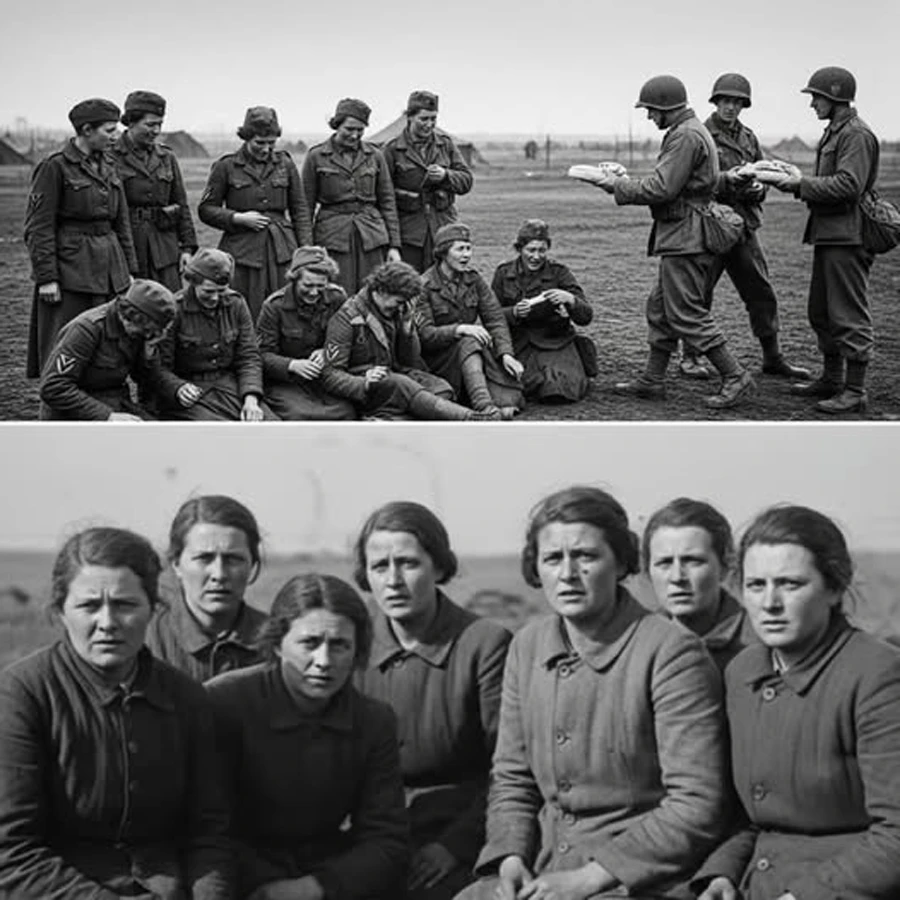
Inside one of the trucks, a group of German women huddled together under the sagging canvas. They had been nurses, clerks, communications auxiliaries, medics—non-combatants swept up in the retreat from France as the Allied armies pushed eastward. Their uniforms were stiff with dried mud. Their legs ached from days of forced marching and rough transport. Hunger gnawed at them with a dull, constant insistence.
When the tailgate finally dropped with a heavy clang, not one of them moved at first.
“Raus,” a voice said—from outside, in German thick with an American accent.
They climbed down slowly, one after another. There were perhaps thirty of them. Every movement cost effort. Some needed help to steady themselves as their boots hit the hard ground.
American soldiers were waiting.
In the growing gloom, the silhouettes looked almost inhuman—helmeted, broad-shouldered figures in bulky coats, rifles slung low. The women had spent years hearing about these men. Wild stories had filtered through the ranks: American troops were savages, criminals, “mongrels” who would take what they wanted from any German who fell into their hands. No mercy, no restraint. Prisoners were starved, beaten, shot out of hand.
Everything in front of them seemed to confirm those warnings. Strange uniforms. Foreign faces. Guns.
The women braced themselves for shouting, for blows, for the beginning of a new kind of terror.
Instead, one of the Americans stepped forward and spoke in a tone that cut through the icy air.
“You are safe now,” he said. “Come—follow us.”
The words were simple. The accent thick. But the meaning was unmistakable.
Safe.
The women exchanged quick, disbelieving glances. Fear didn’t vanish, but for a moment it loosened its grip. This did not match the captivity they had been promised.
They were led toward a long, low wooden building—the processing hall of a temporary prisoner-of-war camp. Inside, the kerosene lamps cast a murky yellow light. The walls smelled of wood smoke, damp wool, and the faint, sour scent of too many bodies in too small a space.
They formed a line as instructed, shoulders slumped, eyes down.
An American sergeant walked slowly down the row, a clipboard in his hands. He checked name tags and papers, occasionally asking a question in halting German. The silence was heavy, broken only by the rustle of paper and the scrape of boots.
About halfway down the line, one woman leaned forward. She had been upright by sheer force of will, but now that will was almost spent. When she spoke, her voice was so faint the sergeant almost didn’t hear it.
“We ate nothing for a week,” she whispered.
The sergeant stopped.
He looked at her properly then. Really looked. Saw the deep hollows under her eyes, the way her hands trembled, the tightness of skin over cheekbones. He glanced along the line at the others—the drawn faces, the too-thin wrists, the dullness in their eyes that came from more than fear.
Nearby American personnel noticed the pause. For a second or two, no one spoke, but something passed between them. An understanding.
Whatever those women had been yesterday—enemy, auxiliary soldier, a piece of the machinery of war—right now, in this moment, they were simply starving human beings.
The sergeant’s jaw tightened.
“Get the cooks,” he said quietly.
A young corporal, cheeks red with cold, broke into a run across the frozen ground toward the mess hall.
On paper, the United States Army had clear rules. The War Department had circulated detailed instructions on the treatment of prisoners of war, in accordance with the Geneva Convention: captured soldiers, regardless of their country, were entitled to proper rations, shelter, and medical care. The regulation existed. But seeing someone in a manual and seeing a hungry woman in front of you were two different things.
In the mess kitchen, huge pots were already bubbling. American soldiers were preparing their own evening meal. When the corporal stumbled in, breathless, blurting out that a group of female prisoners hadn’t eaten in days, the cooks exchanged a look. It lasted a fraction of a second.
“Load the trays,” one of them said. “They eat first.”
They moved with that peculiar speed people get when they know exactly what they’re doing. Biscuits came out of the ovens—golden, warm, the crusts still flaky. Thick white gravy, made from meat drippings and flour, was ladled into heavy metal pitchers. Pans of boiled potatoes and vegetables were dragged from stovetops. Cornbread, split into squares, piled high. Enamel mugs were filled with coffee so hot it steamed even in the warm kitchen.
It wasn’t fancy. It wasn’t a holiday feast. It was army food—heavy, simple, designed to stick to ribs and keep men going in winter mud.
To women who had eaten nothing but scraps and hope for a week, it might as well have been royal banqueting.
When the women were ushered into the mess hall, they stopped in the doorway as if they had hit an invisible wall.
The air inside was warm. Heat from the stoves and steam from the food wrapped around them, carrying scents they hadn’t known in months: freshly baked bread, meat, coffee. Light from bare bulbs made the metal serving line gleam.
For a moment, none of them moved. One woman’s hand flew to her mouth as tears filled her eyes.
A cook stepped forward and held out a tray piled high—biscuits half-drowned in gravy, a scoop of potatoes, a spoonful of vegetables, a piece of cornbread, and a mug of coffee.
He placed it carefully in the hands of the woman who had whispered about not eating. Her fingers closed around the tray as if it might be snatched away.
“This is for us?” she asked, her voice barely more than a breath.
The cook nodded. His accent was strange, his words simple.
“You eat,” he said. “No one is taking it.”
What happened next stuck with the American guards for years.
They had seen hungry people before, in France and Belgium and along the roads through shattered villages. They’d seen liberated forced laborers tear into food with desperate, animal ferocity, shoving it into their mouths with shaking hands.
But these women did something else.
They moved deliberately to the benches. They sat, backs straightening as if they were once again in a place where posture mattered. They adjusted their ragged uniforms. Then they picked up their utensils and began to eat.
Slowly.
Carefully.
With a quiet dignity that was all the more heartbreaking for the way their cheeks were hollow and their hands quivered.
They didn’t talk much between bites. Some closed their eyes briefly with each mouthful. Warmth spread from their stomachs outward, chasing numbness from fingers and toes. For the first time in days, something other than fear filled their bodies.
Afterward, medics came.
They checked pulses, listened to hearts, asked through an interpreter about illnesses and injuries. They noted dehydration, exposure, weight loss. When the examinations were over, the women waited for the scolding they were sure would come. They had shown weakness. They had needed help.
No one raised a voice.
Instead, wool blankets were draped over shoulders. Thin shoes were replaced with sturdier ones. They were guided to barracks where a pot-bellied stove glowed dull red in the corner.
In the flickering light of burning coal, they held out their hands to the warmth.
For years they had been fed a certain story: enemy soldiers were animals. They would abuse prisoners at the first opportunity. Capture meant degradation as much as defeat. Nothing about that evening fit what they had been taught.
One American nurse, called in to check them, remembered it afterward.
“They weren’t soldiers anymore, not in that moment,” she said. “They were just young women who needed help. That’s all I saw.”
In the days that followed, a routine settled into place. The women joined the rhythms of a temporary POW camp: morning roll call under a pale sky, work details cleaning kitchens or mending uniforms, lines at the field post for mail that rarely came, lights out at nine.
But when they later spoke about their time in American hands, what they described first was not the discipline or the boredom.
It was that night.
The shock of walking into a warm mess hall expecting nothing and finding plates set out.
The bewildering taste of biscuits and gravy.
The feeling of being fed “like their own,” as one woman put it years later, still surprised by the memory.
For the Americans involved, it was just one more night on an endless campaign calendar. They went back to peeling potatoes and cleaning rifles. The cooks who ladled gravy onto those trays probably forgot the faces of the women by the following spring.
The women did not forget.
Back in Germany, years later, interviews with former prisoners kept circling back to the same scene. They had truly believed the enemy would treat them with cruelty. They had been prepared to meet hatred with hatred, fear with fear.
Instead, on a freezing winter evening in a wooden building lit by smoky lamps, strangers had answered four simple words—“We ate nothing for a week”—with stoves full of food, blankets, and a kind of respect that slipped past propaganda and lodged someplace deeper.
It was not a grand gesture. No flags were raised over that mess hall. No speeches were made. No cameras recorded it.
It was just a handful of men deciding that the regulations about feeding prisoners were worth following even when no one was watching, that starving women deserved a hot meal regardless of what uniform they wore yesterday.
In the middle of a world war, that was all it was.
And for those women, it was enough to start rewriting what “enemy” meant.