
Elijah and Nia Sinclair disappeared in Utah’s red-rock desert in 2010. For eight years, the “official” story said they perished unprepared. Then a government crew reopened a Cold War mine and found skeletons seated together, sealed inside. The artifacts beside them exposed greed, betrayal, and a chilling cover-up.
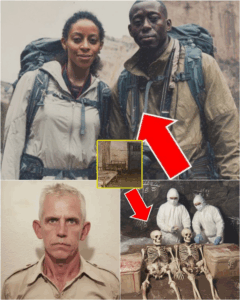
Tourists Vanished in the Utah Desert in 2010 — In 2018 Skeletons Were Found Seated in a Sealed Mine
In the scorched, red-rock wilderness of Utah’s San Juan County, the summer of 2010 swallowed two promising young lives with barely a ripple.
Elijah Sinclair, a 28-year-old doctoral student in geology from Atlanta, had come to Utah chasing a thesis about Cold War uranium mines. His wife, Nia, 26, an acclaimed photographer whose work appeared in cultural magazines, joined him to document the journey. The couple had been married only two years.
Their last known contact was a text message to a friend: “Setting up camp near Fry Canyon. Heading toward the abandoned shafts tomorrow.”
They were never seen again.
A Disappearance Brushed Aside
When the pair didn’t return, search teams scoured the desert. Helicopters hovered over mesas, volunteers combed arroyos, and trackers studied faint footprints that ended abruptly in the sand.
Days turned into weeks. No bodies, no gear, no camera equipment. Nothing.
At a brief press conference, the county sheriff stated bluntly: “They likely wandered too far, underestimated the desert, and succumbed to exposure. It happens more often than people think.”
Behind the podium, Elijah’s and Nia’s families stood stunned. But the verdict stuck. The case was closed as “death by misadventure.”
For eight years, that was the accepted truth.
The Blast That Changed Everything
In June 2018, a federal reclamation crew was assigned to seal several abandoned uranium mines considered hazardous to hikers. Most were forgotten relics of a fevered mid-20th century boom that left scars across Navajo lands.
One shaft, however, puzzled workers: its entrance was crudely sealed from the inside, stacked with timbers and rocks. The engineers assumed it was a collapse. They placed charges, cleared debris, and entered.
Inside, illuminated by headlamps, sat two skeletons side by side. Torn clothing clung to brittle bones. One skull bore braided strands of hair still attached.
The scene was disturbingly deliberate: both bodies were propped against a wall, as though seated, facing the entrance that had been blocked.
Evidence Left Behind
Scattered between them was a small cache:
A broken Nikon camera, film cartridges still inside.
A field notebook labeled E. Sinclair, 2010.
Rusted canteens, a camping stove, and unopened packets of dehydrated food.
The notebook’s final entries stopped abruptly in late July 2010.
One page, shaky in handwriting, read:
“They said we shouldn’t have come here. Someone doesn’t want this photographed. Entrance blocked. We can’t get out.”
Another, more haunting:
“If this is found, know we were together until the end.”
Challenging the Official Narrative
The discovery reignited everything the sheriff’s department wanted forgotten. The Sinclairs hadn’t wandered aimlessly into the desert and died of heat. They had ended up inside a sealed uranium mine.
How had they entered? And who—or what—sealed them in from the inside?
Investigators developed several troubling theories:
Industrial Secrets: Elijah’s research suggested unreported contamination from the uranium mines. Local companies, fearful of lawsuits, had strong motives to silence him.
Historical Cover-Up: Nia’s photographs might have shown evidence of radioactive waste dumped illegally decades earlier. If published, they would have embarrassed state and federal agencies.
Targeted Threats: Several Navajo families testified that strangers in unmarked trucks harassed residents who spoke about abandoned mines near their lands.
A Web of Greed and Neglect
The uranium boom of the 1940s–1960s brought profits to corporations but left devastating fallout across Indigenous communities. Cancer rates skyrocketed. Mines were abandoned without cleanup. By the 2000s, lawsuits piled up.
Elijah, deep into his doctoral work, had begun connecting contamination patterns to specific shafts. Nia was photographing luminous green ore still scattered across playgrounds and sheep corrals.
If their evidence had been published, it would have strengthened billion-dollar claims against both corporations and government agencies.
Instead, the couple vanished.
The Camera’s Silent Witness
Technicians managed to recover images from Nia’s damaged camera. Several frames showed her smiling beside Elijah near the mine entrance. The final shots, blurred but unmistakable, revealed fresh timbers stacked inside the shaft, as though someone was sealing it while they were still there.
No faces, no license plates—only shadows.
Families Demand Justice
For the Sinclairs’ families, the 2018 discovery was both closure and agony.
“Eight years we were told they just got lost,” said Elijah’s mother at a press conference. “They didn’t get lost. They were silenced.”
Civil rights groups, environmental activists, and Navajo Nation leaders joined the families in demanding a federal inquiry.
But after months of headlines, momentum waned. Agencies pointed fingers, records “went missing,” and the mine was quietly resealed.
The Desert’s Chilling Reminder
Today, hikers occasionally leave flowers at the fenced-off shaft. Locals whisper that at night you can still hear faint echoes in the wind—like voices calling from deep stone corridors.
Whether one believes the supernatural or not, the physical truth remains: two bright young people entered Utah’s desert to expose hidden dangers. They were found seated together, sealed away, their story almost erased.
Conclusion
The case of Elijah and Nia Sinclair lingers as one of Utah’s most haunting desert mysteries. Officialdom prefers the tidy version: two tourists, unprepared, who perished by accident. But the evidence found in 2018 tells another tale—of warnings ignored, profits protected, and lives sacrificed.
As one activist said after the discovery: “The Sinclairs were buried twice—once by whoever sealed that mine, and again by the silence that followed.”
And the desert, vast and indifferent, still holds more secrets beneath its red stone than we may ever want to uncover.
News
Dolor, silencio y amor: la etapa compleja que vive Kike Morandé y la sentida despedida que reveló su historia más íntima
Impacto y reflexión: Kike Morandé atraviesa una etapa compleja mientras la despedida pública de su esposa expone una historia íntima…

Cuando todos miraban hacia otro lado: la confesión de Américo y Yamila Reyna que marca un antes y un después
Lejos de los rumores y frente a frente con la verdad, Américo y Yamila Reyna revelan una decisión personal que…

La frase que todos esperaban escuchar: Marcelo Salas admite una verdad íntima que transforma su historia dentro y fuera del fútbol
Sin esquivar preguntas, Marcelo Salas sorprende con una confesión personal a los 51 años que cambia para siempre la manera…

La revelación más inesperada de Alexis Sánchez: a los 37 años habla por primera vez de su vida familiar y muestra una faceta desconocida
Nadie lo esperaba: Alexis Sánchez rompe el silencio sobre su círculo más cercano y revela una faceta desconocida que redefine…

Cuando nadie lo imaginaba: Daniel Alcaíno confirma que será padre a los 53 años y revela el cambio profundo que redefinió su vida
Sin máscaras y lejos del personaje, Daniel Alcaíno sorprende al país: anuncia una nueva paternidad, confiesa sus miedos y comparte…
Con palabras quebradas y emoción contenida: la hija de Jorge Hevia Flores confirma su partida y revela el legado de una voz irrepetible
Impacto en el mundo de las comunicaciones: la emotiva despedida familiar que expone la historia desconocida, los últimos días y…
End of content
No more pages to load