The little girl cried and told the police: ‘I don’t want to sleep in the basement anymore.’ When the officers went down to check, they were shocked to see the truth… – News

The little girl cried and told the police: ‘I don’...

The little girl cried and told the police: ‘I don’t want to sleep in the basement anymore.’ When the officers went down to check, they were shocked to see the truth…
The little girl cried and told the police: ‘I don’t want to sleep in the basement anymore.’ When the officers went down to check, they were shocked to see the truth…

The little girl cried and told the police: ‘I don’t want to sleep in the basement anymore.’ When the officers went down to check, they were shocked to see the truth…

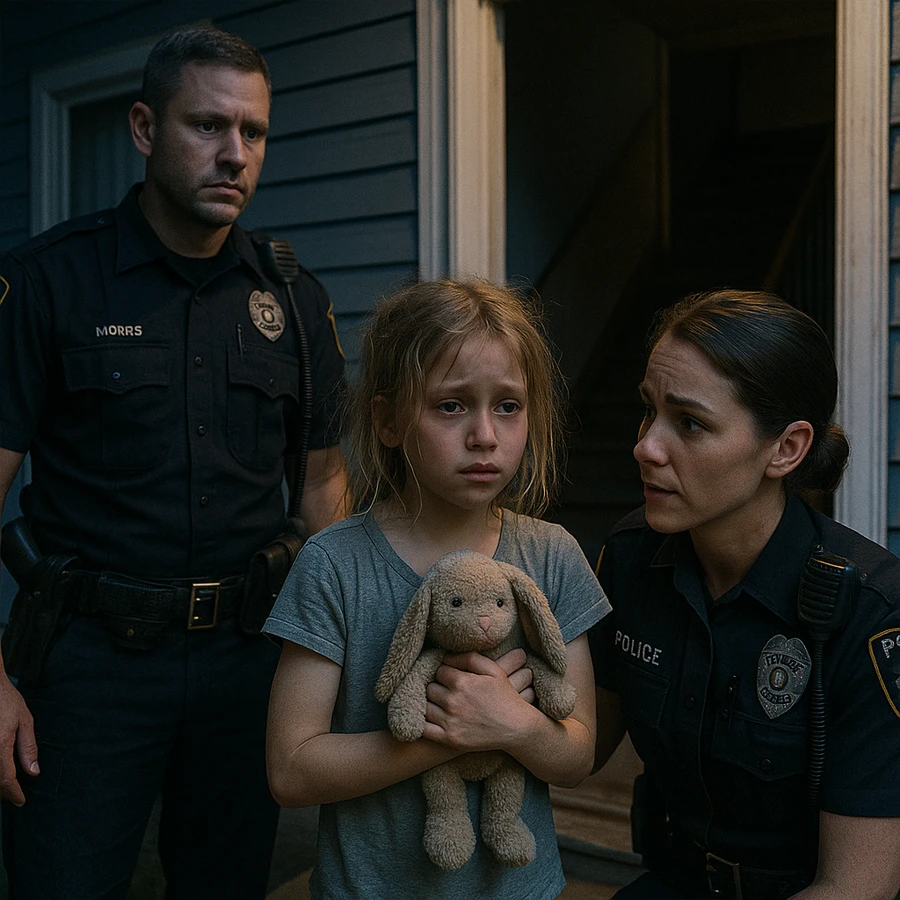
It started on a quiet Thursday evening in Cedar Falls, Iowa. Officer Daniel Morris and his partner, Officer Claire Turner, were dispatched to a suburban neighborhood after a neighbor reported hearing a child screaming. When they arrived, a frail nine-year-old girl named Emily stood on the porch of a modest two-story house. She had messy blonde hair, tear-streaked cheeks, and a trembling voice.

Prenatal paternity tests

“I don’t want to sleep in the basement anymore,” she sobbed, clutching a worn-out stuffed rabbit to her chest.

The officers exchanged a look. Children complained about chores or strict parents all the time, but there was something in Emily’s eyes—an exhausted, haunted look—that made Daniel’s stomach tighten. Claire knelt beside her and asked softly, “Emily, can you tell us what’s in the basement?”

Emily only shook her head and whispered, “It’s cold. It’s dark. I hear things. Please don’t make me go back.”

With the permission of her stepfather, Carl Jennings, who had reluctantly opened the door for them, the officers proceeded inside. Carl was a stocky man in his forties, wearing a stained T-shirt and jeans. He forced a smile, insisting that Emily was “just being dramatic” and that she sometimes “liked to play games with strangers.”

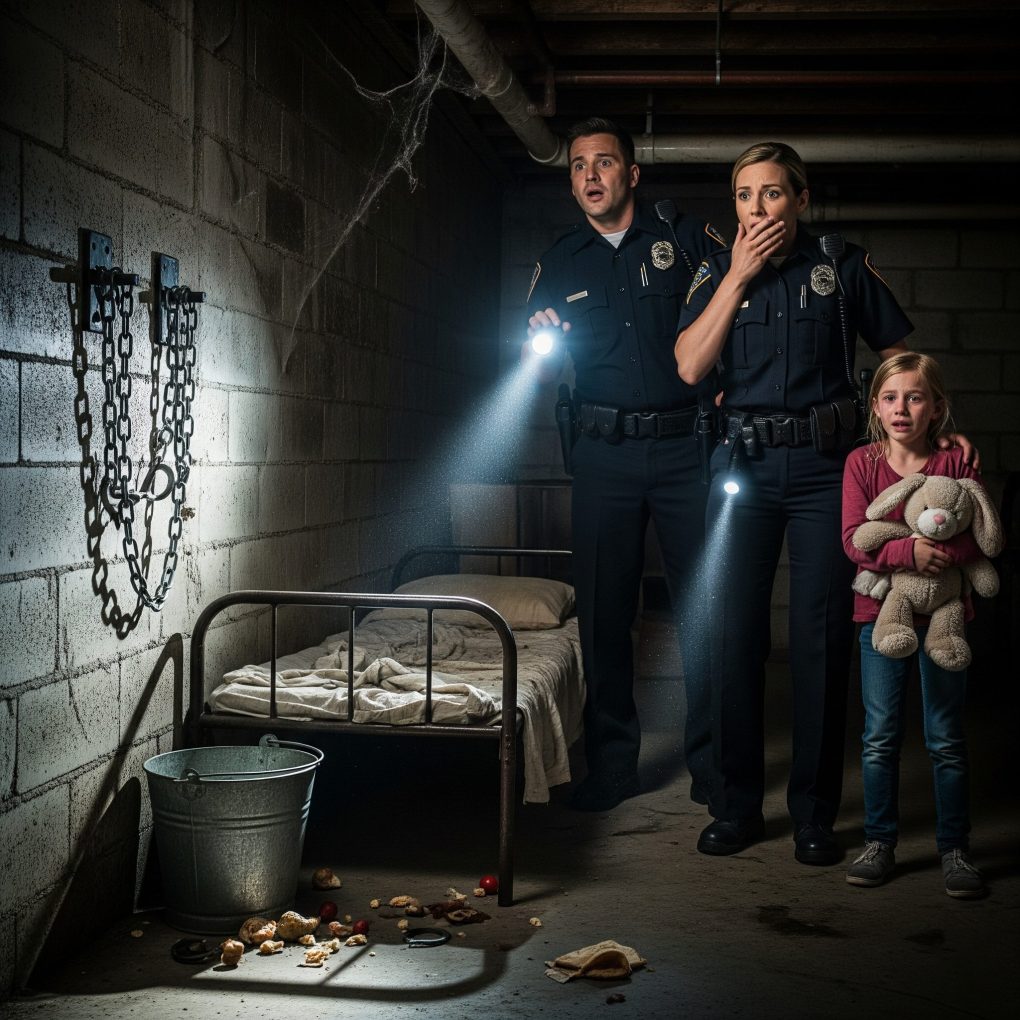
Still, procedure required them to check the home. The basement door creaked open with a groan. Daniel flicked on his flashlight and started down the narrow staircase. The air grew damp and heavy, filled with the faint smell of mildew and something else—something metallic.

When his beam of light swept across the concrete floor, Daniel froze.

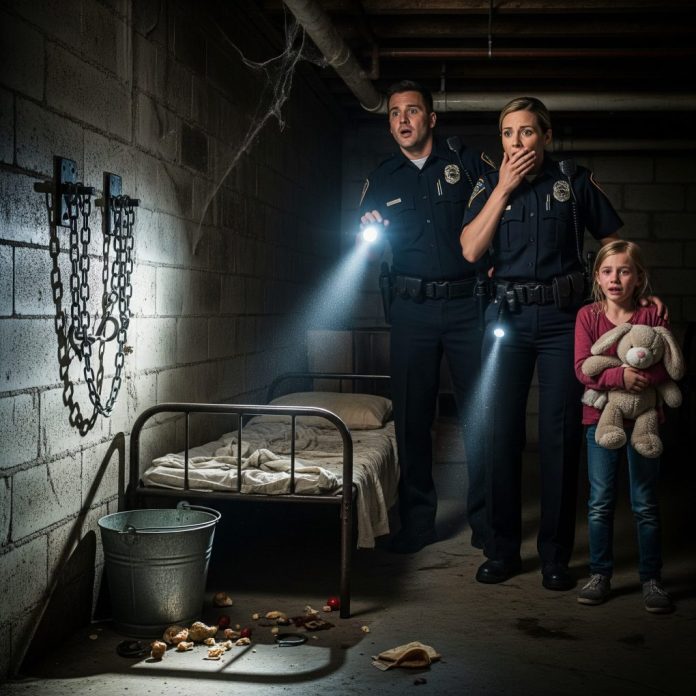
Against the far wall stood a cot with thin, soiled sheets. Next to it lay a bucket half-filled with dirty water. A cracked plate with scraps of old food sat on the ground. Chains—actual steel chains—were bolted into the wall, with a child-sized ankle cuff attached.

Claire gasped audibly behind him.

Emily hadn’t been exaggerating. She had been living here. Sleeping here.

Daniel’s jaw clenched as he turned back toward Carl, who was lingering at the top of the stairs, arms crossed, his expression darkening. “Carl Jennings,” Daniel said, his voice sharp, “step back. Right now.”

Emily whimpered behind Claire, burying her face in the officer’s uniform.

The truth was out. And it was far worse than anyone expected.
Carl Jennings was handcuffed on the spot. His protests echoed through the quiet house as Officer Daniel Morris pressed him against the wall.

“This is a mistake! She’s lying—she makes things up all the time!” Carl shouted, veins bulging in his neck.

Daniel ignored him. The chains in the basement told a story no excuse could erase. Meanwhile, Officer Claire Turner gently guided Emily into the living room, where the girl curled up on the couch, holding her stuffed rabbit tightly.

Within the hour, Child Protective Services (CPS) and detectives from the Cedar Falls Police Department arrived. The scene shifted from a routine call to a full-scale investigation. Photos were taken of the basement: the cot, the chains, the bucket, the scraps of food. Every detail was documented.

Prenatal paternity tests

Detective Sarah Coleman, a seasoned investigator with twenty years on the job, sat down with Emily. Her voice was calm, steady, the kind children trusted.

“Emily,” she began softly, “can you tell me how long you’ve been sleeping in the basement?”

Emily’s eyes flicked toward the floor. “Since my mom… since she went away.”

“Where’s your mom now?” Sarah asked.

Emily hesitated, then whispered, “In the hospital. She got sick. Carl said I had to stay in the basement so I wouldn’t bother him.”

Prenatal paternity tests

Sarah’s pen hovered above her notepad. “Did he ever hurt you?”

Emily clutched her rabbit tighter. “Sometimes… when I cried too much.” She rolled up her sleeve slightly, revealing faint bruises along her thin arm.

The room fell silent except for the scribbling of Sarah’s pen.

Back in the kitchen, Daniel and Claire spoke with a neighbor, Mrs. Helen Ramirez, who had been the one to call 911. “I heard her screaming,” Helen said, shaking her head. “I thought maybe it was just a tantrum, but it went on for too long. I couldn’t ignore it anymore.”

Helen admitted she had often seen Carl in the yard but rarely Emily. “I thought she was just shy,” she added, guilt lacing her tone.

Carl, meanwhile, sat in the back of a patrol car, cursing under his breath. He continued to insist he was “just disciplining a difficult child” and that the police had no right to interfere. But the evidence was overwhelming.

That night, Emily was placed in temporary foster care with a local family while her mother’s whereabouts were confirmed. Daniel drove her to the foster home himself. She fell asleep in the backseat, her small head resting against the  window.

Family counseling
Parenting classes

For Daniel, the sight of the little girl—finally sleeping peacefully, no chains, no darkness—was both a relief and a heavy burden. He had seen many things in his career, but the image of that basement cot would stay with him forever.

The investigation was just beginning, but one thing was certain: Emily was never going back to that basement.

The case against Carl Jennings moved quickly once the details of Emily’s situation came to light. Prosecutors charged him with multiple counts of child endangerment, unlawful imprisonment, and aggravated assault. The photographs of the basement, along with Emily’s testimony, were enough to ensure he would never walk free without answering for what he had done.

Prenatal paternity tests

But while Carl sat in county jail awaiting trial, the focus shifted to Emily’s future.

Two weeks after her rescue, Emily’s mother, Laura Jennings, was released from the hospital. She had been recovering from complications related to pneumonia, a battle that had left her bedridden for months. She had believed Carl’s promises when he said he would “take care of everything” while she got better. What she never imagined was that he had forced her daughter into a basement like a prisoner.

When Laura finally reunited with Emily at the Department of Human Services office, both clung to each other, crying. Emily buried her face in her mother’s chest and whispered, “I don’t want to go back there.”

“You never will,” Laura assured her, stroking her hair. “Not ever again.”

Parenting classes

Still, the road ahead was not easy. Court proceedings required Emily to testify, though accommodations were made so she didn’t have to face Carl directly. Therapists began working with her to address the trauma—the fear of dark rooms, the nightmares that jolted her awake at night, and the guilt she carried for not telling someone sooner.

Detective Sarah Coleman stayed in touch, checking in on Emily’s progress. For Sarah, cases like this were the reason she had joined law enforcement in the first place. “She’s strong,” she told Daniel one afternoon in the station. “You can see it in her eyes. She’s going to make it.”

And indeed, slowly, Emily began to heal. She started attending a new elementary school, where teachers described her as shy but bright. In art class, she drew pictures of houses filled with light and families smiling together. When asked about the drawings, she simply said, “That’s how I want my home to be.”

Family counseling

Carl Jennings eventually pleaded guilty after realizing the evidence was overwhelming. He received a lengthy prison sentence, ensuring he would not have another chance to harm Emily or anyone else.

Months later, during a sunny spring afternoon, Daniel happened to run into Laura and Emily at a local park. Emily was on the swings, laughing with another girl her age. The sight was almost unrecognizable compared to the terrified child he had first met on that dark evening.

Laura walked over to thank him again. “You and Officer Turner saved her life,” she said. “I don’t know how to ever repay that.”

Daniel shook his head. “You already have. She’s safe. That’s all that matters.”

Prenatal paternity tests

As Emily swung higher, her laughter carrying through the park, Daniel allowed himself a rare smile. The memory of the basement would never fully leave him, but at least now it had been replaced with something brighter—a reminder of resilience, hope, and the power of one child’s courage to speak up.

Related Articles

News 1 day ago

En la primavera de 1971, Lorine Deweiler gastó cuarenta y cinco dólares en 212 patos enfermos que nadie quería y los llevó a un terreno pantanoso que el condado llevaba treinta años intentando drenar sin éxito. Los vecinos se rieron, su familia creyó que estaba desperdiciando la herencia de su padre y los funcionarios aseguraron que una mujer sola nunca podría convertir barro en producción. Sin embargo, Lorine no había actuado por impulso: llevaba cuatro años estudiando el agua, la vegetación y los cuadernos secretos de su padre. Cuando llegó la crisis agrícola de los años ochenta, los mismos hombres que se burlaron perdieron tierras, maquinaria y hogares, mientras la mujer de los patos compraba granjas en efectivo y transformaba el terreno más despreciado del condado en el suelo más fértil de toda su propiedad.

  Part 2: Lorine utiliza investigación, paciencia y chatarra contra el pantano El costo total…

News 1 day ago

En 1971, Lorine Shrock gastó cuarenta y cinco dólares en once lotes de láminas de techo dobladas, oxidadas y rechazadas por un molino de Wisconsin, mientras todo el condado se reía de la mujer que había abandonado una beca universitaria para cuidar a su padre enfermo y trabajar una granja que nadie consideraba especial. Lo que sus vecinos creyeron una compra impulsiva era en realidad el primer paso de un plan calculado durante meses, basado en conocimientos de metalurgia aprendidos desde la infancia, herramientas completamente pagadas y un mercado olvidado entre comunidades que valoraban la duración más que la apariencia. Durante doce años, Lorine enderezó errores ajenos, convirtió basura industrial en material útil y acumuló dinero sin pedir un solo préstamo. Cuando la crisis agrícola arrasó cuarenta y una granjas del condado, la mujer ridiculizada apareció en una subasta, escribió un cheque personal por ciento quince mil dólares y obligó a todos a comprender que nunca habían estado observando a una granjera obstinada desperdiciar dinero, sino a una constructora silenciosa transformando aquello que el mercado no sabía valorar.

  Part 2: Las manos de su padre convierten errores industriales en material valioso Walter…

News 1 day ago

La mañana en que Riddle Creek se secó por completo, Martha Bell entró en el cauce con una pala mientras treinta y una vacas mugían de sed detrás del granero y sus vecinos se preparaban para verla perder la granja. Todos creían que aquella viuda de cincuenta y dos años estaba excavando una fantasía nacida del duelo, porque ningún banco valoraba un arroyo estacional y ningún hombre del pueblo recordaba agua bajo aquellas piedras. Pero Martha había encontrado musgo vivo, barro frío, un círculo de piedra y una nota escrita por su esposo muerto que mencionaba un secreto enterrado desde 1947. Lo que comenzó como una excavación ridiculizada terminaría salvando su ganado, protegiendo ciento cuarenta acres y revelando que la peor sequía en décadas no había destruido la verdad. Solo había eliminado suficiente tierra para que alguien paciente pudiera verla.

  Part 2: Un mapa de 1912 convierte una sospecha en una misión A la…

News 1 day ago

Cuando el banco declaró que treinta y una acres cubiertas de barro, sauces y juncos no tenían ningún valor, Nathan Klein arriesgó sus vacas, su maquinaria y el futuro de su familia para comprar la propiedad que todos evitaban. Los vecinos se burlaron mientras él se negaba a drenar completamente el pantano y construía un extraño sistema de canales, senderos y potreros alrededor del agua. Su primer año casi terminó en desastre, pero durante la peor sequía en tres décadas, aquella tierra despreciada se convirtió en el único pasto todavía vivo. Entonces el banco, los vecinos y hasta su propia hermana comprendieron que Nathan nunca había comprado un pantano: había comprado una fuente de supervivencia que nadie se había tomado el tiempo de entender.

  Part 2: Nathan se niega a destruir aquello que necesita comprender Durante el resto…

News 1 day ago

Cuando trescientas personas vieron una cadena de hierro tensarse entre un tractor John Deere de casi medio millón de dólares y una máquina de vapor construida en 1915, nadie dudó de cómo terminaría la competencia. Walter Hayes tenía setenta y tres años, una granja al borde de la ejecución hipotecaria y apenas cuarenta y cinco caballos de fuerza frente a seiscientos veinte. Su hija llevaba meses sin hablarle, el banco preparaba la orden que destruiría cuatro generaciones de trabajo y el joven propietario del tractor moderno necesitaba ganar para demostrarle a su padre que no había desperdiciado su vida. Pero Walter conocía la tierra, conocía su máquina y conservaba un secreto escrito por su padre junto a una válvula roja: úsala solamente cuando perder signifique perder quién eres.

  Part 2: Un padre distante, una hija ausente y una carta bancaria esperan A…

News 1 day ago

Trescientas personas acudieron a una feria rural de Tennessee convencidas de que presenciarían la humillación pública de un granjero anciano, endeudado y aferrado a una máquina de vapor construida en 1915. Frente a él esperaba un John Deere de casi medio millón de dólares, equipado con seiscientos veinte caballos de fuerza, sensores digitales y un joven propietario decidido a demostrarle a su padre que había elegido correctamente su vida. Nadie sabía que Walter Hayes estaba a pocos días de perder la granja de su familia, que su hija viajaba desde Chicago para reconciliarse con él ni que un secreto mecánico transmitido durante tres generaciones estaba a punto de convertir una competencia agrícola en una lección inolvidable sobre honor, conocimiento y promesas.

  Part 2: Seiscientos veinte caballos encuentran una resistencia inesperada Cuando la bandera descendió, el…

News 1 day ago

Durante seis años, Brandon Fletcher utilizó la pobreza, la enfermedad y el viejo tractor de Donald Mitchell como material de ventas, convenciendo a los agricultores de Iowa de que cualquier hombre que no comprara maquinaria nueva estaba condenado al fracaso. Entonces, frente a quinientas personas, desafió al granjero de setenta y cuatro años a competir contra un John Deere de casi medio millón de dólares. Nadie creía que un Farmall de 1952 pudiera sobrevivir, mucho menos ganar. Pero Donald conocía algo que Brandon jamás había aprendido en una sala de exhibición: la tierra no responde al precio de una máquina, sino al conocimiento de quien la trabaja. La apuesta terminaría destruyendo una reputación, salvando una granja y obligando a toda una comunidad a recordar lo que el progreso había hecho olvidar.

  Part 2: Una venta rechazada transforma la enfermedad en humillación pública En 2017, un…

News 1 day ago

Durante tres días, una excavadora de seiscientos mil dólares se hundió lentamente en un pantano de Iowa mientras ingenieros, grúas, excavadoras modernas y modelos informáticos fracasaban uno tras otro. Cuando un granjero de setenta y tres años llegó ofreciendo rescatarla con una máquina de vapor construida en 1912, el poderoso dueño de la constructora se rio delante de cuarenta trabajadores. Sin embargo, aquella reliquia familiar no solo arrancaría sesenta toneladas del barro; también destruiría la arrogancia de un empresario, cambiaría la educación de varios ingenieros y demostraría durante generaciones que algunas soluciones nunca quedan obsoletas: simplemente esperan a que alguien recuerde por qué fueron creadas.

  Part 2: Una máquina olvidada despierta para enfrentar lo imposible La Case de ciento…

News 1 day ago

Durante veintiséis años, Jonathan Wright fue ridiculizado por leer cada palabra antes de firmar cualquier contrato, mientras sus vecinos confiaban en apretones de manos, banqueros conocidos y cláusulas que nadie se molestaba en revisar. Cuando la crisis agrícola de 1983 llevó a un banco de Iowa a exigir el pago inmediato de catorce préstamos, trece familias descubrieron demasiado tarde que tres palabras escondidas en una página podían destruir generaciones de trabajo. Jonathan fue el único que se negó a inclinar la cabeza. Había preparado aquella defensa desde los dieciséis años, cuando vio a su padre perder ciento veinte acres por confiar en un amigo. Sin embargo, salvar su granja no lo convirtió en un hombre feliz: lo dejó rodeado de ruinas, aislado de sus vecinos y obligado a decidir si la prudencia que lo protegió también lo había condenado a vivir solo.

  Part 2: Un joven agricultor convierte la sala de un banco en su escuela.…

News 1 day ago

Un anciano cubierto de barro entró en un concesionario de maquinaria agrícola y pidió comprar doce tractores John Deere en efectivo, provocando las carcajadas del dueño, quien creyó estar frente a un granjero pobre y confundido. Minutos después, una llamada bancaria confirmó que aquel hombre tenía millones disponibles, pero el dinero era apenas la parte menos sorprendente de su historia. Detrás de sus botas desgastadas se escondían una infancia destruida por una ejecución hipotecaria, un hijo enterrado demasiado pronto, una esposa moribunda y una promesa capaz de transformar el futuro de decenas de familias agrícolas durante generaciones.

  Part 2: Una infancia destruida convierte el dolor en propósito Kenneth nació en Marshalltown…