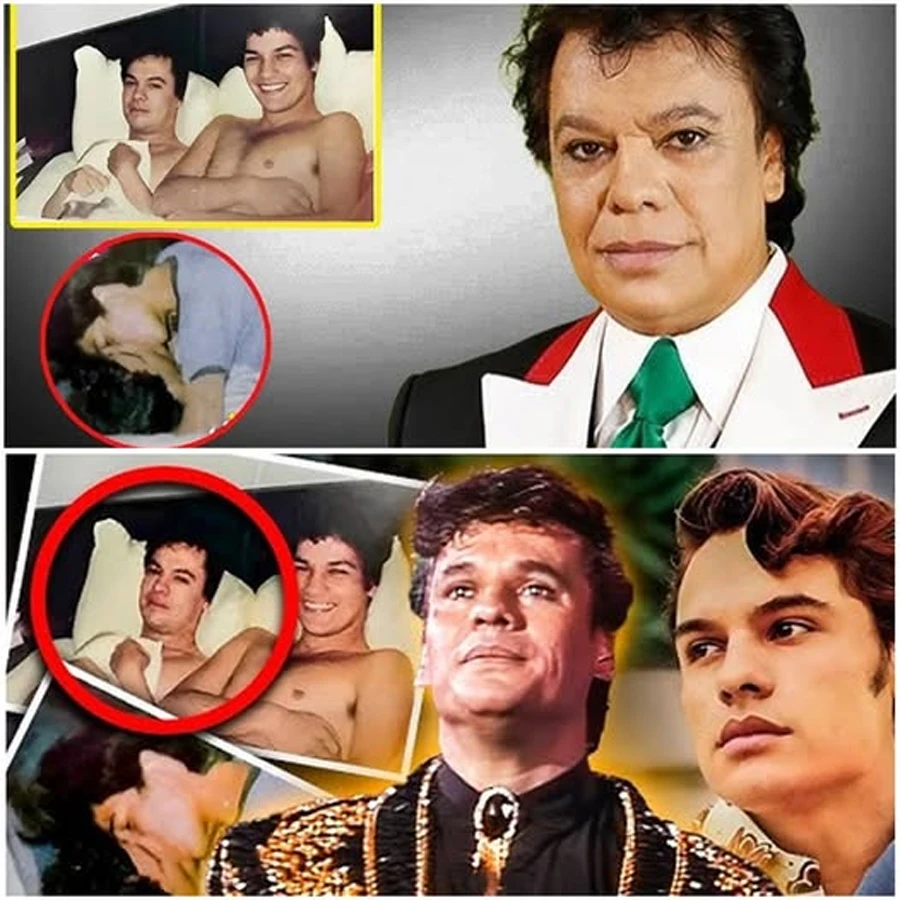
The hidden truth: why Juan Gabriel never admitted to being gay
Juan Gabriel’s greatest mystery resurfaces: why the icon who gave Mexico unforgettable songs never admitted his true orientation, choosing silence, ambiguity and mystery that only fueled the legend around his name and his legacy.
Years have gone by since the world said goodbye to Juan Gabriel, but his name continues to resonate with the same force as his music. With a career that broke records and an artistry that crossed borders, the Divo de Juárez became more than a singer—he became a cultural icon. And yet, behind his radiant costumes, unique performances, and hundreds of songs dedicated to love, heartbreak, and passion, lies a mystery that the artist never resolved: his sexual orientation.
The unanswered question
Throughout his career, Juan Gabriel faced constant speculation about his private life. The press, fans, and critics repeated the same question: was he gay? He never denied, but he never confirmed either. His choice was silence, and that silence became one of the most iconic aspects of his personality.
The famous quote
In one of his most remembered interviews, a journalist asked him directly: “Are you gay?” Juan Gabriel responded with a phrase that would become legend:
“Lo que se ve no se pregunta” (What you see doesn’t need to be asked).
With that simple answer, he avoided labeling himself, yet at the same time, he fed the intrigue. It was the perfect mix of deflection and confirmation.
Why the silence?
There are many theories about why Juan Gabriel never publicly admitted anything:
The cultural context: He began his career in the 1970s, when Mexican society was deeply conservative. Openly coming out could have meant censorship, rejection, or even the end of his career.
The image of the idol: For millions of fans, Juan Gabriel wasn’t just a singer—he was the personification of love itself. By keeping his orientation ambiguous, he allowed everyone to identify with his songs, whether man or woman.
His own personality: Close friends said he didn’t like labels. He believed in love without definitions, in affection beyond gender, and preferred to let his music speak for him.
The legend grows
Ironically, the mystery surrounding his sexuality only fueled his fame. His flamboyant costumes, his exaggerated movements on stage, and his unmistakable mannerisms were interpreted as part of his artistic genius. His persona blurred the line between private truth and public performance.
For some, his silence was an act of protection. For others, it was a strategy to keep alive the enigma that made him irresistible.
A private life, carefully guarded
Despite his fame, Juan Gabriel kept his personal relationships away from the spotlight. He was known to be intensely private about family matters, his children, and his closest companions. Rarely did he allow anyone to step beyond the curtain of his public persona.
This discretion reinforced the aura of mystery: the more he avoided clarifying, the more people speculated.
Fans didn’t care—he was love incarnate
What’s undeniable is that his audience never turned its back on him. Whether straight, gay, bisexual, or beyond any label, Juan Gabriel’s fans adored him. For many, his songs became hymns of heartbreak and celebration, regardless of who sang them or to whom they were dedicated.
“Querida,” “Amor eterno,” “Abrázame muy fuerte”—his lyrics spoke of universal feelings that transcended gender or orientation. That was perhaps his greatest triumph: making everyone feel included.
After his death: the unanswered
When Juan Gabriel died in 2016, the question resurfaced louder than ever. Documentaries, books, and gossip columns tried to reconstruct his intimate life. Some close to him hinted at romances, others insisted on discretion. The truth remains unconfirmed.
And maybe that was exactly what Juan Gabriel wanted: to leave a mystery that would never be solved, ensuring his legend lived forever.
Silence as strategy, silence as shield
His silence can be interpreted in two ways. It may have been a shield, protecting him in an era when homophobia was rampant and dangerous. Or it may have been a strategy, a way to remain enigmatic and let people focus on his art.
Perhaps it was both.
The legacy that matters
In the end, the unanswered question about Juan Gabriel’s sexuality doesn’t overshadow his legacy. He sold more than 100 million records, composed over 1,800 songs, and became one of the most prolific figures in Latin music.
What remains is his music, his presence, and the love he poured into every verse.
Conclusion: the eternal enigma
The hidden truth of why Juan Gabriel never admitted to being gay will probably never be fully revealed. Maybe he didn’t want to. Maybe he thought it unnecessary. Maybe he understood better than anyone that mystery was part of his magic.
What is certain is that his silence created one of the greatest enigmas in Latin music. And even in death, Juan Gabriel continues to be the Divo de Juárez—immortal, universal, and unforgettable.