“Please… Do It Quick,” She Whispered — The Rancher Handed Her $1… Then Shocked Everyone
“When a Stranger Whispered ‘Please… Do It Quick,’ the Rancher Reached Into His Pocket and Handed Her a Single Dollar — But What Happened Next Left the Entire Town Speechless and Changed the Course of His Life Forever.”
The afternoon sun was brutal over the wide plains of Montana, its golden light spilling across miles of dry grass and weathered fence posts.
Samuel “Sam” Harper, a rancher in his mid-fifties, was riding back to his property after a long day rounding up cattle. Dust clung to his boots and hat; his body ached, but his spirit was steady — the kind of resilience that only comes from decades of hard work and solitude.
He lived alone now. His wife, Clara, had passed five years earlier. His son, Ben, had moved to the city, chasing dreams of modern life. For Sam, the ranch was his world — the creak of the barn, the scent of hay, and the endless sky that reminded him every day that freedom had a cost.
But on that particular evening, something unusual happened — something that would turn into one of the most talked-about stories in the small town of Red River.
The Stranger by the Road
As Sam’s pickup truck rolled down the dirt road toward town, he spotted a figure walking along the roadside. It was rare to see anyone out there — especially a woman.
She looked young — maybe late twenties — but exhausted, her clothes covered in dust. She carried no bag, just a small folded coat in her arms.
Sam slowed down and leaned out the window.
“You alright, miss?” he called out.
She hesitated, then turned toward him. Her eyes — a pale, tired blue — met his.
“I… I need help,” she said softly. “Please… do it quick.”
Her voice trembled, barely above a whisper.
Sam frowned. “Quick? What do you mean?”
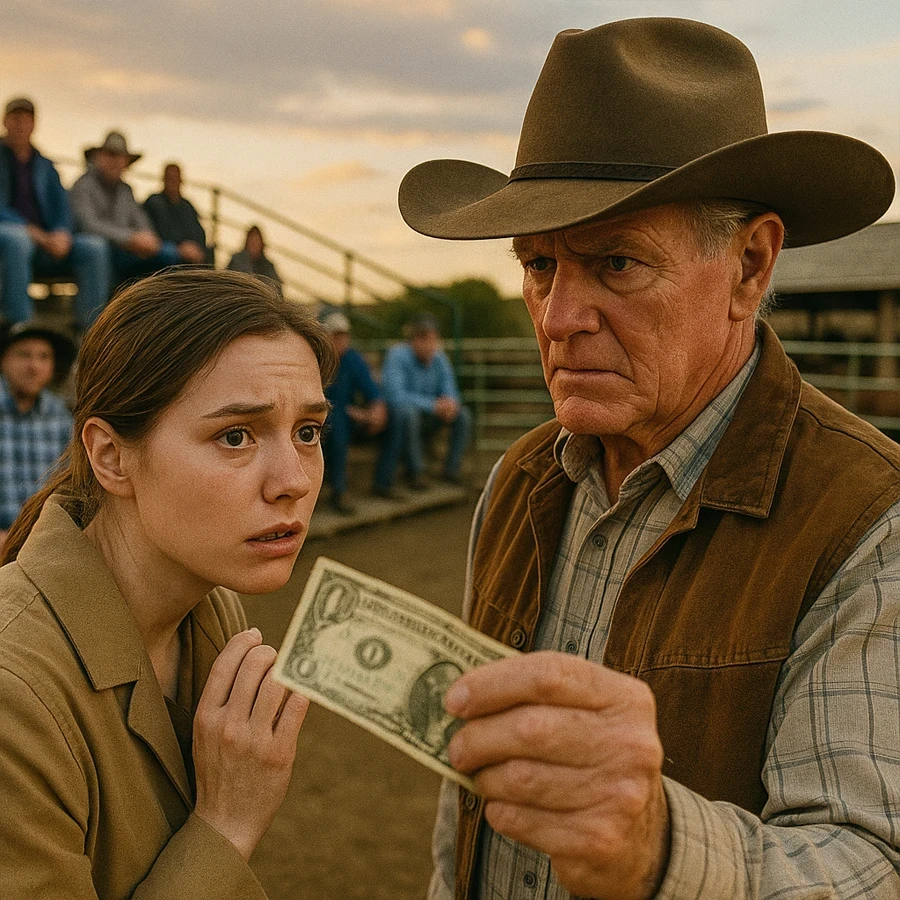
She lowered her gaze. “I just need… a dollar.”
The Dollar
Sam blinked. Of all the things she could’ve asked for, a single dollar made no sense.
“You sure that’s all you need?” he asked cautiously.
She nodded. “Please. Just one dollar. And then I’ll go.”
Her tone was urgent but strangely calm, as if the weight of her world hung on that tiny sum.
Sam studied her for a moment. Her face was thin, her hair tangled from wind and dirt, but there was something else — a quiet dignity, a strength beneath the desperation.
Without another word, he reached into his worn leather wallet, pulled out a single crumpled dollar bill, and handed it to her through the truck window.
“There you go,” he said kindly. “No strings attached.”
She took it gently, her hands trembling.
“Thank you,” she whispered. “You don’t know what this means.”
Before Sam could ask another question, she turned and started walking toward the nearby old gas station, now half-abandoned.
Something about the scene — her fragility, the mystery — gnawed at him. Against his instincts, he put the truck in park and followed.
The Gas Station
The gas station had been closed for years — a relic from another time, its pumps rusted, its windows boarded.
But behind it, Sam saw the woman kneeling beside a small box hidden under a pile of wood.
He watched as she unfolded a faded piece of paper, then carefully placed the dollar inside the box, next to several other worn bills.
It wasn’t money she was after — not really.
Sam finally stepped closer. “Miss, what are you doing out here?”
Startled, she froze.
“I told you not to follow,” she said softly, tears glinting in her eyes.
“I wasn’t trying to pry,” Sam said, keeping his distance. “But I’m not leaving a young woman alone out here in the middle of nowhere.”
She sighed, looking at the box. “This is where my mother used to bring me when things got bad. She’d tell me that someday, we’d leave town and start over. We’d save one dollar at a time.”
Sam glanced at the pile of bills — perhaps fifteen or twenty at most.
“And now?” he asked gently.
“She’s gone,” the woman said quietly. “Cancer took her last winter. I came back to finish what she started.”
Her words hit him like a punch.
“I thought if I left the last dollar… maybe it would mean something. Maybe it would set her free.”
A Past Revisited
They stood in silence for a long moment. The wind carried the smell of sagebrush and rain.
“What’s your name?” Sam finally asked.
“Lila,” she said. “Lila Henderson.”
“Where you headed, Lila?”
She shrugged. “Nowhere. Everywhere. Just… away.”
Sam nodded slowly. He saw something in her that reminded him of his younger self — the restless urge to escape pain by running toward the horizon.
“You got anyone waiting for you?” he asked.
She shook her head. “No. Just my mom. And she’s waiting somewhere I can’t reach.”
Sam felt an ache deep in his chest.
“Listen,” he said quietly. “You don’t owe me anything, but I’ve got a spare room at the ranch. A warm meal. If you need a place to stay tonight, it’s yours.”
She hesitated, studying his face — looking for signs of pity, or worse, deceit. But what she found was sincerity.
Finally, she nodded. “Just for tonight.”
The Dinner Table
That evening, the ranch house came alive in a way it hadn’t for years.
Sam cooked stew and cornbread — his wife’s old recipe. Lila ate quietly, her eyes scanning the photographs on the walls.
“Your wife?” she asked, pointing at a picture of a woman holding a baby foal.
Sam nodded. “Clara. She passed a few years ago.”
“I’m sorry.”
He smiled faintly. “So am I. She was the light around here.”
For the first time that night, Lila smiled too. “You’re lucky to have had someone like that.”
Sam looked down. “We all have someone like that. The hard part is realizing it before they’re gone.”
They talked long into the night. Lila told him about her childhood — growing up poor, her mother working two jobs, the dollar jar they filled for their “someday.”
By the time they finished dessert, Sam had made a decision he didn’t fully understand.
“Stay as long as you need,” he told her. “Work’s hard, but it’s honest. And I could use an extra pair of hands around the ranch.”
Lila blinked, surprised. “You’d hire me? Just like that?”
He shrugged. “I’ve made worse choices.”
The Months That Followed
Weeks turned into months.
Lila became part of the ranch — fixing fences, feeding the horses, cooking breakfast when Sam overslept. Her laughter filled the empty house, and for the first time in years, Sam felt the echo of life again.
But Lila carried her past like a shadow. She still visited the gas station once a week, leaving a single dollar each time.
“It’s my promise,” she told Sam once. “To her. To never forget where I came from.”
Sam didn’t question it. Some promises, he knew, kept people alive.
The Rumor
Then one morning, the peace shattered.
A black SUV pulled into the ranch, and a man in a suit stepped out. He flashed a badge.
“Mr. Harper?”
“That’s me,” Sam said cautiously.
“I’m Detective Moore with the Red River Police Department. We’re investigating the disappearance of a woman named Lila Henderson.”
Sam froze. “What do you mean, disappearance?”
“She vanished six months ago,” the detective said. “Her employer reported it. We tracked her phone — last signal was near your property.”
Sam’s heart pounded. “She’s not missing. She’s been living here.”
The detective’s brow furrowed. “Here?”
Before Sam could explain further, Lila stepped out of the barn — pale, holding a bucket of water.
The detective’s eyes widened. “Miss Henderson, you have no idea how much trouble you’ve caused.”
The Truth Behind the Story
Inside, the tension was thick.
The detective explained that Lila had worked as a housekeeper for a wealthy family in the city. When her mother died, she fell into depression and disappeared, leaving behind a note that many interpreted as a goodbye letter.
They thought she had taken her own life.
“I didn’t mean to scare anyone,” Lila said quietly. “I just… needed to start over.”
The detective sighed. “You could’ve told someone.”
“I didn’t know how.”
Sam spoke up. “She’s done nothing wrong. She’s worked here, honest and decent.”
The detective studied him, then nodded slowly. “Legally, she’s free to stay. But she might want to let people know she’s alive.”
After the SUV left, Lila sat on the porch, staring at the sunset.
“Guess I can’t run forever,” she murmured.
Sam handed her a mug of coffee. “No one can. But maybe you don’t have to anymore.”
The Dollar Jar
That evening, Lila took Sam to the old gas station one last time.
She lifted the wooden box where the dollar bills lay and placed the final dollar inside — the one Sam had given her that first day.
“This one’s special,” she said softly. “It was the first act of kindness I got when I thought the world had forgotten me.”
Sam smiled gently. “You gonna keep coming back here?”
She shook her head. “No. I think it’s time to stop saving for ‘someday.’ I think it’s time to live.”
The Twist
Months later, a letter arrived for Sam, sealed in a plain envelope. Inside was a bank document — a check written in his name, worth $500,000.
The note attached was short:
“Dear Mr. Harper,
You once handed a stranger a dollar without asking anything in return.
That dollar changed everything.With gratitude,
—L.H.”
Sam sat in stunned silence. The money was from a trust fund belonging to Lila’s late mother — one she had finally accessed after reconnecting with the authorities.
But instead of using it all, she chose to share it with the man who had believed in her when no one else did.
Epilogue: The Dollar That Saved Two Lives
Years passed. The old gas station finally collapsed under the weight of time, but the story of the dollar — and the rancher who gave it — became local legend.
Sam never spent a cent of that money. Instead, he created The Dollar Promise Foundation, helping struggling families in Red River rebuild their lives one act of kindness at a time.
He kept one thing on his mantel: the original dollar bill, now framed behind glass.
Whenever someone asked him why he kept it, he’d smile and say:
“Because that’s how much a second chance costs — just one dollar, and a little bit of faith.” ❤️