He Fed a Homeless Woman Breakfast Every Morning—Then the Military Knocked on His Door and Asked One Question That Made His Knees Go Weak: “Where Is Captain Álvarez?”
He Fed a Homeless Woman Breakfast Every Morning—Then the Military Knocked on His Door and Asked One Question That Made His Knees Go Weak: “Where Is Captain Álvarez?”
Marco Rodriguez was thirty-two, and no matter how many times he scrubbed, his hands always smelled like burnt oil and old metal. That scent lived in the creases of my fingers the way the city lived in your lungs—permanent, stubborn, impossible to wash out.
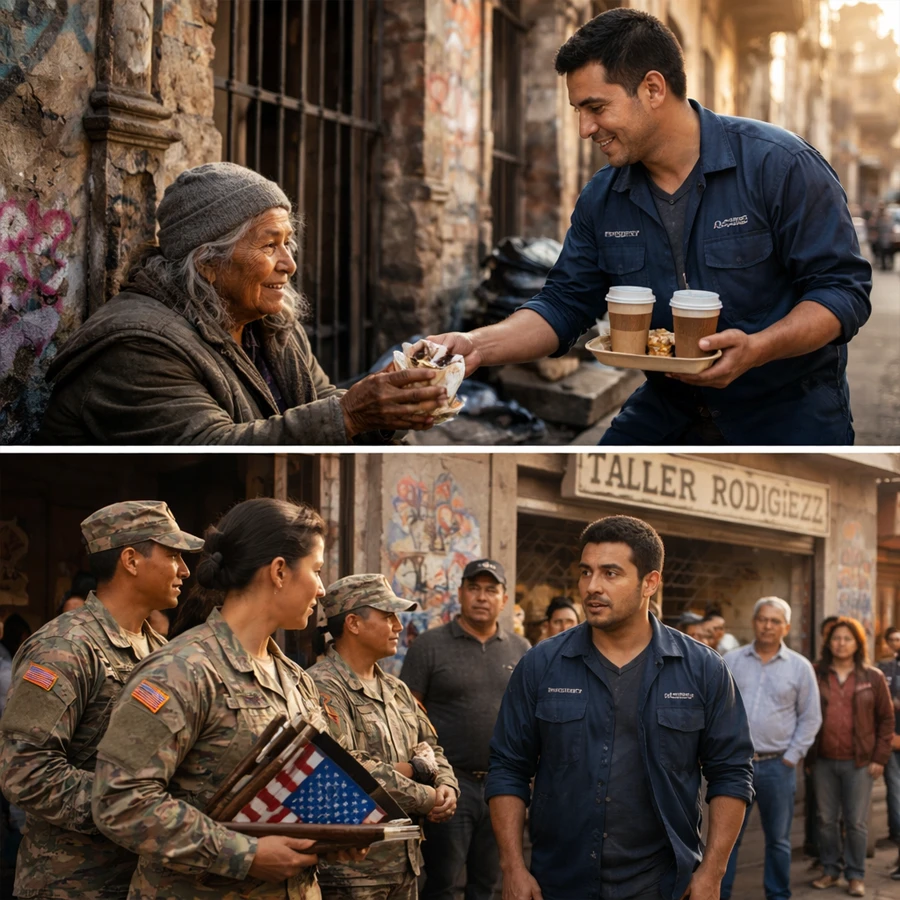
I rented a small apartment toward Iztapalapa, the kind of place where the traffic started before the sun and the nights didn’t bring peace so much as exhaustion. My workshop sat two streets off a main avenue—cramped, loud, faithful—beneath a faded sign that read:
Taller Rodriguez
It wasn’t a dream. It was survival.
The shop barely covered rent, electricity, and the kind of savings you call “future” just to feel less afraid. I didn’t have a new car. I didn’t have brand clothes. But I did have a habit everyone called strange.
Every morning, before lifting the metal curtain of my workshop, I crossed two streets, bought a small pot of coffee and a sweet bread—sometimes a concha, sometimes a cuernito—and walked toward the abandoned church near La Merced.
It was older than the neighborhood that swallowed it. Its walls were tagged and peeled. Its gate hung like a tired jaw. Wires cut across the sky like scars. And there, on the porch—always in the same corner where the wind didn’t bite as hard—slept a homeless woman.
The first time I saw her, it was just a shape under a blanket that used to be blue. The second time, I noticed her shoes were tied with string. The third time, I heard her cough and realized she wasn’t going to make it through the winter without someone noticing she was a person.
So I started leaving breakfast.
Not a sermon.
Not a lecture.
Just coffee and bread, placed close enough that she could reach it without standing in the cold.
At first, she didn’t speak. She would watch my hands—my oily hands—like she didn’t trust anything that came from a man who worked with tools. But she took the food. Carefully. Like it might disappear if she moved too fast.
On the fourth morning, she said:
“Why?”
I shrugged. “Because it’s morning.”
She stared at me a long time. Her eyes were sharp, the kind that didn’t match the rest of her. Most people who lived on the street had eyes that floated, tired, detached. Hers… hers aimed.
“I’m not a charity box,” she said.
“I’m not a charity man,” I answered. “Just hungry sometimes. Figured you might be too.”
That made her mouth twitch, like she was trying not to smile.
“Marco,” I said, because it felt wrong to keep feeding someone whose name I didn’t know.
She hesitated.
“Luz,” she finally replied.
It wasn’t a name you forgot. Luz. Light.
And in the weeks that followed, I learned she carried her own strange habits too.
She always slept with her back to the wall.
She never let anyone stand behind her.
And when sirens passed, her fingers would twitch like she was reaching for something that wasn’t there.
I told myself she was just scared.
But deep down, I knew fear didn’t make you move like that.
Training did.
1
The shop guys teased me at first.
“Saint Marco,” Chuy laughed, wiping grease off his cheek with the back of his arm. “You saving the world one concha at a time?”
I pretended to be offended. “I’m saving her from your attitude.”
They laughed and let it go, the way people in the city let things go because there’s always another problem waiting.
But the truth was, the routine became the steadiest thing in my life.
Coffee.
Bread.
The church steps.
Luz.
Sometimes she’d be awake, sitting with her knees to her chest, watching the street wake up. Sometimes she’d be asleep and I’d leave breakfast and step away quietly like you do around fragile things.
One morning it was raining so hard the gutter water looked like it was boiling. I found her shivering, her blanket soaked through.
I didn’t think. I just shrugged out my own jacket and held it out.
She stared at it like it was a trap.
“You’ll catch a cold,” she said.
“Already caught one,” I lied. “Take it.”
She didn’t take it immediately. She looked at my face like she was measuring my intention, like she’d been burned by kindness before and didn’t plan to be fooled twice.
Then she accepted it with the smallest nod.
That day, she spoke more than usual.
Not about her past—never that.
About the city.
About how it sounded different before dawn.
About how the church had once been full of music, back when she was a girl. She claimed she could still hear the echo if she sat still enough.
“You used to come here?” I asked.
She didn’t answer directly.
“I used to belong somewhere,” she said instead.
I wanted to ask where. I didn’t. Some people tell their stories like gifts. Others tell them like wounds. I wasn’t going to pick at hers.
But I noticed things.
A scar on her wrist, thin and pale, like a blade had kissed her years ago.
A ring-shaped mark around her finger, as if she’d worn something there for a long time and then stopped.
The way she’d scan every face that passed the corner, not with curiosity, but with assessment.
Once, a man stepped too close to her—one of those loud guys who treat street people like furniture.
“Hey, señora,” he said, leaning in. “You got anything for me?”
Luz didn’t flinch.
She just angled her body.
Not away.
Toward him.
Her voice dropped low and calm—too calm.
“Take one more step,” she said, “and you’ll regret it.”
The man laughed.
Then he saw her eyes.
He stepped back, muttering, suddenly less brave.
When he left, I exhaled like I’d been holding my breath.
“What was that?” I asked.
She looked at me like I’d asked what the sky was.
“Survival,” she said.
Then she added, almost to herself:
“And discipline.”
2
The day everything changed started like any other.
I bought the coffee pot. I bought two conchas because the vendor smiled like she knew my routine. I walked toward the church with my collar up against the cold.
But Luz wasn’t there.
The corner was empty. The blanket was gone. No trace.
At first, my brain did the reasonable thing: She moved.
People moved all the time. Especially people with nothing, because “nothing” can be stolen even easier than “something.” Maybe she found a warmer spot. Maybe she got into a shelter.
Still, a weight settled in my chest.
I sat on the church steps with the coffee going cold in my hand, staring at the space where she always slept.
Ten minutes passed.
Then I heard soft footsteps.
Luz appeared from around the side of the building carrying a cardboard box.
Her hands looked red from the cold, but she held the box like it mattered.
“I thought you left,” I blurted.
She stopped, surprised by the worry in my voice.
“I don’t leave,” she said. “Not without a plan.”
She set the box down and opened it.
Inside were things I’d never seen her have: folded clothes, a small first-aid kit, two paperback books, and a photograph tucked inside a plastic bag.
My eyes caught on the photo.
It wasn’t clear. It looked old. But it showed three people.
A woman in uniform.
A man with a stiff smile.
And a little boy on someone’s shoulders.
Luz saw me looking and snapped the box shut immediately.
“That’s private,” she said.
“Sorry,” I muttered.
She studied my face for a long moment.
Then, for the first time since I’d known her, her voice softened.
“You’re consistent,” she said. “Most people aren’t.”
I didn’t know what to do with that.
So I did what I always did when feelings got too big: I offered food.
“Breakfast,” I said, holding out the concha.
She accepted it, but her gaze stayed on me.
“Why do you do this, Marco?” she asked again, quieter now.
I shrugged. “Because you’re here.”
She swallowed, like those words were harder than they should be.
Then she said something that didn’t make sense at the time:
“If anyone asks about me… you didn’t see me.”
I frowned. “Who would ask?”
Luz looked toward the street, where people moved like a river that never cared who drowned.
“Someone who doesn’t like loose ends,” she said.
3
The next morning, the knock came before dawn.
Hard. Precise. Not like a neighbor. Not like a customer.
I opened my apartment door and found three soldiers standing in the hallway.
Not movie soldiers. Real ones.
Cold faces. Crisp uniforms. Boots that didn’t squeak. One of them carried a folder. Another kept his hand near his belt like habit, not threat.
My heart dropped into my stomach.
For a second, I thought: They’re here for me.
For some unpaid fine, some paperwork mistake, some wrong place wrong time. In Mexico City, you learn not to assume you’re safe just because you haven’t done anything wrong.
“Marco Rodriguez?” the one with the folder asked.
“Yes,” I managed.
He glanced at the paper.
“May we come in?”
My mouth went dry. I stepped aside because refusing felt like inviting disaster.
They entered my small living room, and suddenly my cheap furniture looked even cheaper.
The leader—his name tag read SERRANO—didn’t sit. He looked around like he was memorizing exits.
“We’re looking for a woman,” he said.
“A woman?” I repeated, stupidly.
He opened the folder and pulled out a photograph.
My stomach tightened.
It was Luz.
But not the Luz I knew.
In the photograph, she wore a uniform. Her hair was tied back. Her eyes were the same—sharp, unwavering—but her posture was different. Stronger. Official.
Under the photo was a name:
CAPITÁN LUCÍA ÁLVAREZ
I stared at it, unable to breathe.
“That’s… that’s Luz,” I whispered.
Serrano watched my reaction carefully.
“You know her?”
I swallowed. My mind flashed back to her warning: If anyone asks about me… you didn’t see me.
But the soldiers were already here. The question had already found me.
“Yes,” I said, voice shaky. “I know her.”
Serrano nodded once, as if confirming something.
“We’ve had an open file,” he said. “Captain Álvarez has been missing for years.”
Missing.
That word hit like a punch.
“She’s alive?” I asked.
Serrano’s eyes softened almost imperceptibly.
“We believe so,” he said. “We believe she’s been living under a different name.”
He took a breath.
“Yesterday, a message came through an old channel. A location. A name. Your name.”
My knees went weak.
“Me?” I croaked.
Serrano looked down at the folder again.
“She requested contact,” he said. “Indirectly. She said you were trustworthy.”
I didn’t know whether to feel proud or terrified.
“What do you want with her?” I asked, my voice rising. “Because if you’re here to—”
Serrano held up a hand.
“Not to harm her,” he said. “To protect her.”
The second soldier spoke for the first time, his voice quieter.
“She saved lives,” he said. “And she disappeared before she could be honored. We thought she was gone. But her records… her benefits… her medical support… everything is frozen until she’s found.”
Serrano looked me in the eyes.
“Where is Captain Álvarez, Marco?”
My mouth opened.
No words came out.
Because I suddenly understood: Luz wasn’t just a homeless woman.
She was a soldier who had fallen through the cracks so hard she’d ended up on church steps.
And now the military—this whole machine—had come to my tiny apartment because I’d brought her breakfast.
My life felt upside down.
“She… she sleeps by the abandoned church,” I said finally. “Near La Merced.”
Serrano nodded. “Take us.”
“Me?”
“Yes,” Serrano said. “She trusts you. We don’t want her to run.”
The word run made my stomach twist.
Because if Luz ran from them, it meant she was afraid of them too.
4
We arrived at the church just after sunrise.
The city was already waking up, vendors setting up, buses groaning, people rushing like life was a race they couldn’t win.
The soldiers moved with purpose, but they didn’t draw weapons. They didn’t bark orders. Still, the sight of them made nearby pedestrians slow down, eyes wide, curiosity buzzing in the air.
I led them to the porch corner.
It was empty.
My heart dropped.
“Luz,” I called softly.
Nothing.
Serrano’s jaw tightened. He looked around, scanning every doorway, every shadow.
Then I noticed something on the steps.
A paper cup. Fresh coffee smell.
And beside it, a folded note held down by a small stone.
My name was written on it.
MARCO
My hands shook as I picked it up.
Serrano watched.
I unfolded the note, and the words hit my chest like heat:
Marco,
If they came, it means the old ghosts finally noticed the living.
I’m sorry I pulled you into this. You didn’t ask for my storm.
You gave me mornings. You gave my body time to remember it was worth keeping warm.
They’ll tell you I’m a hero. Don’t believe the clean story.
I did what I had to. I also survived what I shouldn’t have had to survive.
I’m going to a place where I can get help without hiding behind a church.
I left you something under the third loose tile by the side door.
You’ll know what to do with it.
Thank you for seeing me.
—Luz
I stared at the note until the words blurred.
Serrano stepped closer.
“She left?” he asked.
I nodded, throat tight.
“Where?” he demanded, but there was no anger in it—just urgency.
“I don’t know,” I whispered. “But she’s alive.”
Serrano exhaled, relief flickering in his face.
“Good,” he said. “Good.”
Then he added, quieter:
“We’ll find her.”
The soldiers began to move, coordinating, radioing quietly.
I stood frozen with the note in my hand.
Under the third loose tile.
My stomach churned.
I walked to the side door of the church, where the tiles were cracked and uneven. I crouched and pressed my fingers along the edge until I found one that shifted.
I pried it up.
Underneath was a small metal box wrapped in plastic.
My hands trembled as I opened it.
Inside were two things:
A worn military ID tag on a chain.
A folded photograph—newer than the one I’d seen in her box.
In the photo, Luz stood in uniform, smiling faintly, holding a young soldier by the shoulders. Behind them was a banner with a date.
At the bottom, scrawled in her handwriting:
“Tell him I kept my promise. Tell him I made it out.”
Serrano saw the ID tag and swallowed hard.
“That’s hers,” he said softly, as if speaking too loud might break something.
“Who’s ‘him’?” I asked.
Serrano looked at me, and for the first time he seemed less like a soldier and more like a man.
“Her brother,” he said. “He’s still in service. He never stopped looking.”
My chest tightened.
All those mornings, I’d given her coffee and bread, thinking I was helping one person.
But she’d been carrying an entire unfinished story.
5
The soldiers didn’t arrest anyone. They didn’t drag her out. They didn’t treat her like a criminal.
They treated her like someone they had failed to catch before she fell too far.
Serrano took the ID tag with careful respect.
“Marco,” he said, “you did more than you realize.”
I laughed once, bitter. “I gave her breakfast.”
Serrano shook his head.
“You gave her a reason to believe someone could be safe,” he said. “That matters.”
Before they left, Serrano handed me a card.
“If she contacts you again, call this number,” he said. “Day or night.”
I nodded, still dazed.
As they walked away, the neighborhood watched like it had just witnessed a miracle or a scandal. A few people whispered. One woman crossed herself.
And me?
I just stood there, holding the note, feeling the strange weight of being “ordinary” in a story that had suddenly become bigger than my shop, my rent, my fatigue.
6
Two weeks passed.
No Luz.
No soldiers.
Just the workshop, the grease, the constant city.
But something had shifted inside me.
One morning, I found myself buying coffee and bread out of habit. Then I stopped in the street, staring at my hands.
The porch corner was empty now.
And it hurt more than I expected.
That same afternoon, a letter arrived at the workshop addressed to me. No return address.
Inside was a simple card.
Marco Rodriguez,
Captain Álvarez has been located and is receiving support. She is safe.
On her request, we are informing you that your kindness played a direct role in her recovery.
Thank you for your discretion and your humanity.
—Office of Veteran Affairs
My throat tightened.
Chuy walked by and saw my face.
“What happened?” he asked, suddenly serious.
I stared at the card.
“She’s okay,” I said.
Chuy blinked. “Who?”
I hesitated.
Then I told him the truth—not all of it, but enough.
Chuy stared, mouth open.
“Bro,” he whispered. “You fed a…?”
“Yeah,” I said.
He shook his head like he couldn’t process it.
Then he slapped my shoulder.
“You’re still weird,” he said. “But… I get it now.”
7
Months later, on a quiet morning when the air felt almost gentle, someone appeared at the shop door.
I looked up from an engine and froze.
Luz stood there.
Not in uniform. Not in rags.
In clean clothes. Hair tied back. Shoulders straighter. Still thin, still marked by life—but standing like someone who had reclaimed a piece of herself.
My hands went still.
“Marco,” she said.
I didn’t know what to say.
So I did the only thing I could think of.
I pointed to the plastic chair by the wall.
“Coffee?” I asked, voice rough.
She smiled—small, real.
“Yes,” she said. “If you still do that.”
I set a cup in front of her. My hands shook.
“You’re… okay?” I asked.
She nodded.
“I’m working on it,” she said. “It’s not a switch. It’s… steps.”
I swallowed.
“The military…” I began.
She lifted a hand.
“They didn’t hurt me,” she said. “They helped me. The ones who mattered, anyway.”
She looked down at her cup.
“I didn’t trust anyone in uniform for a long time,” she admitted. “But you taught me something.”
“What?” I asked.
She glanced up, and her eyes were still sharp—but softer now.
“That not everyone who sees you wants something,” she said. “Some people… just bring breakfast.”
I felt my throat burn.
“So what now?” I asked.
Luz breathed out slowly.
“Now,” she said, “I try to live like I survived for a reason. And you… keep being annoying.”
I laughed. A real laugh.
Chuy poked his head out from behind a car.
“Boss,” he called, grinning, “you got visitors now? Should we charge admission?”
Luz raised an eyebrow.
“Is he always like that?” she asked.
“Worse,” I said.
She sipped her coffee.
Then she reached into her bag and slid something across the table.
A small envelope.
Inside was a folded paper with an official stamp.
“Don’t panic,” she said quickly. “It’s not trouble.”
I opened it.
It was a notice: a small grant awarded to Taller Rodriguez for community service and neighborhood support. Enough to fix my roof leak, replace a tool set, maybe even hire one more helper.
I stared at it, stunned.
“I didn’t—” I started.
Luz shook her head.
“You didn’t ask,” she said. “That’s why you deserve it.”
I swallowed hard.
“Thank you,” I managed.
She nodded once, like we’d made a deal without saying it.
Then she looked toward the street, where morning traffic was already building.
“Marco,” she said softly, “when you’re tired, remember this: the world is heavy. But we don’t have to carry it alone.”
I didn’t have a clever answer.
So I just nodded.
And for the first time in a long time, the strange silence of the city at dawn felt a little less like fatigue… and a little more like possibility.