— And we didn’t have money for shashlik, so eat bread and vegetables,” — the bold faces of the relatives stretched in surprise…..
— And we didn’t have money for shashlik, so eat bread and vegetables,” — the bold faces of the relatives stretched in surprise.
Lena stood on the porch of the crooked summer house, examining the peeling boards and the glass yellowed by time. Meanwhile, Andrey kicked the wobbly step of the porch, grimacing at the creak of the rotten wood.
“Well, Lenka,” he sighed, looking around at the warped window frames, “your Aunt Galya was right. It’s all just ruins. Maybe we really should tear it all down?”
“But it’s our ruins,” Lena answered stubbornly, adjusting a strand of hair that had slipped out from under her old headscarf. “And look around — what a plot of land! Old apple trees, cherries… It’s just terribly neglected, but the soil is good.”
When Grandma Zhenya died last winter and left the summer house to her granddaughter as an inheritance, the relatives only laughed behind her back. Aunt Galya whispered to their cousin Ira right at the memorial service, “Well, what a joy Lenka got — a rotten shack on six hundred square meters, only expenses.” And Uncle Vitya, shaking his head, even suggested demolishing everything completely and selling the land to some rich buyer.
“At least something useful will come from that wreck,” he said, sipping vodka from a shot glass.
But Lena was not the type to give up easily. All summer, she and Andrey went to the summer house every weekend, getting up at the crack of dawn. First, they cleared out the junk — old furniture eaten through by bugs, rusty garden tools, piles of yellowed magazines Rabotnitsa and Krestyanka. Then they tackled the roof. Luckily, Andrey was a handyman — patching holes carefully here, completely replacing rotten boards there, and sometimes just painting it all for a fresh look.
Meanwhile, Lena battled the years of weeds from morning till night, bringing the once wild garden back to life. The work was grueling — hands calloused, back aching — but gradually, forgotten flower beds began to peek out from under the overgrowth.
“Look, Andryusha,” she showed her husband excitedly, when by the end of August the first timid flowers poked through the cleared bushes, “peonies used to grow here! And over there were dahlias, see the stumps?”
Of course, there was barely any money for proper repairs, but they had plenty of imagination and enthusiasm. They painted the old window frames bright white — and the house immediately looked fresher, more cheerful. The crooked veranda was sheathed in inexpensive but nice siding, and they covered the floors with leftover laminate they got almost for free from acquaintances after their renovation.
Lena turned out to be quite inventive — she found dozens of decoration ideas online using improvised materials. She painted old flower pots with bright acrylic patterns, made cute flower beds from old car tires, hung homemade planters and woven baskets all over the plot.
By the end of the season, the plot was completely transformed beyond recognition. Lena proudly showed Andrey her new acquisitions — a charming set of woven garden furniture bought at an autumn sale for half price, a small inflatable pool for especially hot days, and a beautiful cast-iron barbecue grill she bought with a discount coupon.
“You know, Lenka,” Andrey said, settling comfortably in a new chair with a bottle of cold beer after another hard day’s work, “we probably did even better than many of our friends with their expensive cottages.”
Lena nodded contentedly, admiring the soft evening sunset through the neatly trimmed apple branches. Yes, it was really nice here. Quiet, peaceful, cozy. Truly their own.
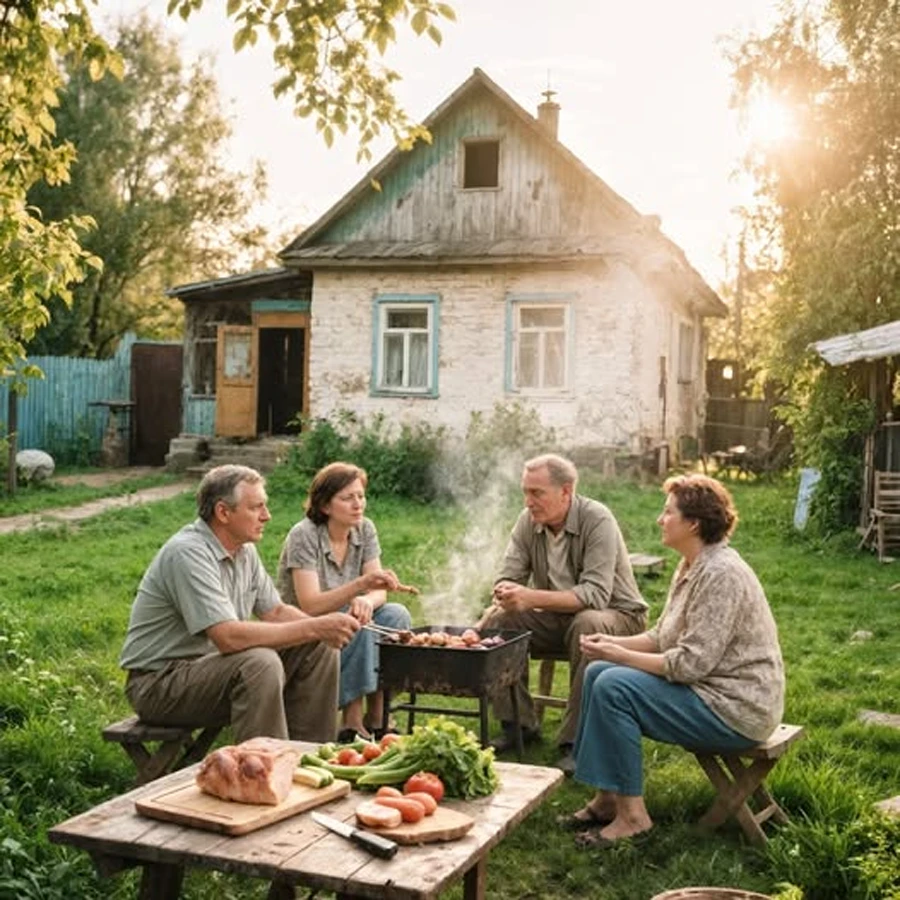
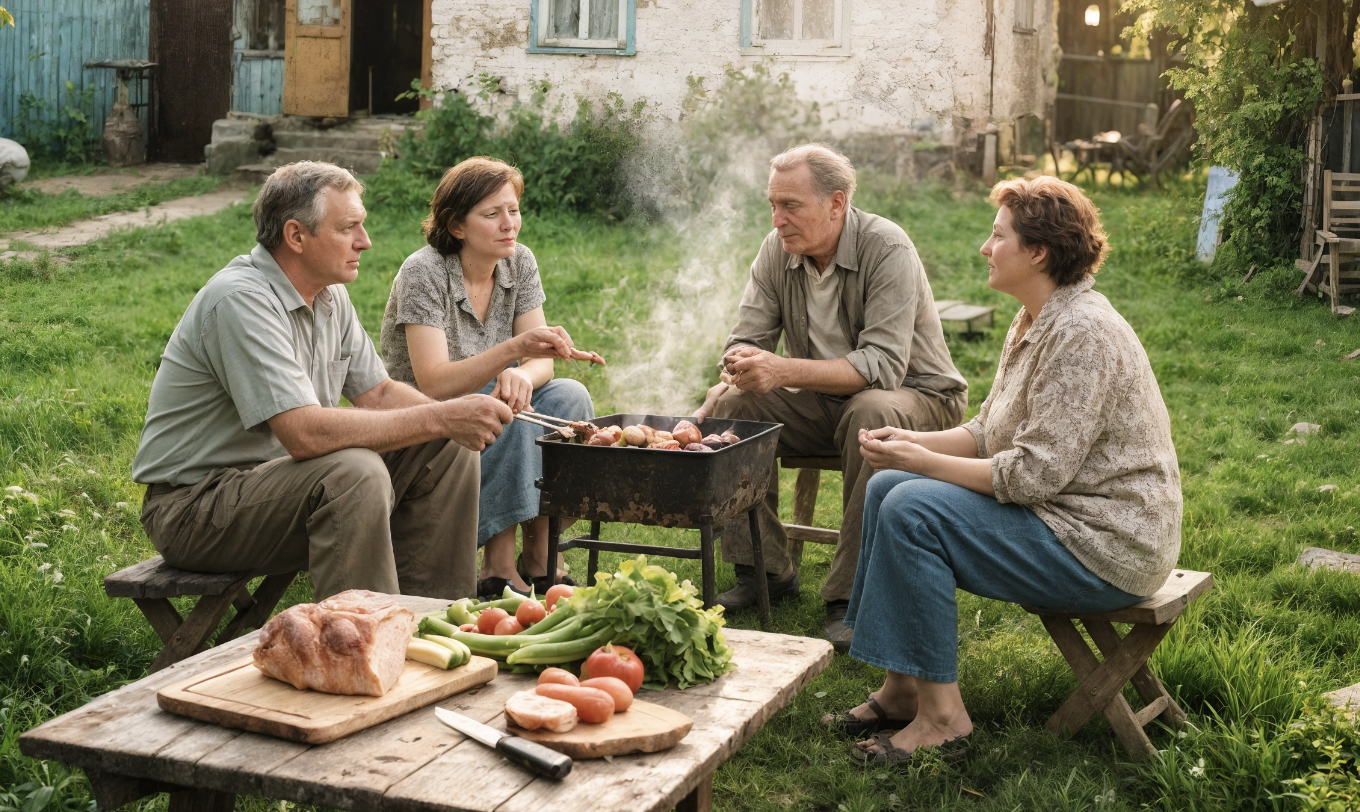
But no sooner had the new summer season begun than their peaceful calm was abruptly shattered. And, just their luck, it happened exactly when they were grilling fragrant kebabs on their brand-new grill. Lena carefully flipped the golden meat pieces, enjoying the process, when the iron gate slammed open, and a whole noisy delegation stormed into the yard — Aunt Galya accompanied by her silent husband Uncle Kolya, Uncle Vitya with his wife Aunt Nina, and cousin Ira with her two restless children.
“Oh, heavens, we’ve arrived just in time!” Aunt Galya exclaimed loudly, greedily surveying the transformed plot with poorly concealed astonishment and, perhaps, even envy. “Lenka, you really turned out to be something! We never imagined you could make such indescribable beauty here!”
“Indeed,” Uncle Vitya readily chimed in, plopping down with his considerable weight into one of the new woven chairs, “this place is completely unrecognizable. And we honestly thought…”
“That I was wasting my time and energy,” Lena calmly finished for him, trying hard to suppress the irritation rising inside her.
“Oh, no, no!” Aunt Galya energetically waved her plump hands. “We always, always believed in you! Right, Vitenka?”
Andrey looked meaningfully and with a slight irony at his wife but wisely remained silent. Meanwhile, the guests had already settled into all the chairs, the children joyfully discovered the inflatable pool and immediately began splashing around.
“The kebabs smell so delicious, how wonderful!” Ira sighed dreamily, casting a meaningful glance at the grill. “We just happened to be passing by and thought to stop… And it worked out so well — we hadn’t really had lunch…”
What could they do? They had to quickly set an improvised table for the whole honest company. The prepared meat barely sufficed for all the guests, but naturally, none of the relatives expressed the slightest dissatisfaction. They eagerly devoured the kebabs, lavishly praised the improvements on the plot, and shared the latest summer house news and gossip.
Lena smiled weakly and nodded along to the conversation, but inside she was boiling with indignation.
“You know, Lenka,” Aunt Galya said near the very end of the long evening, “let’s come visit you every weekend now! We don’t have a summer house, and you’ve created such otherworldly beauty here… And it will be good for the kids to run around in the fresh air.”
“Yes, yes, great idea!” Ira enthusiastically picked up. “And we’ll definitely help you with all the chores, don’t worry!”
However, the promised help boiled down to the children scattering their toys all over the plot in the evening, while the adults drank tea on the veranda and held endless conversations about the neighbors. Naturally, the owners had to clean up the whole mess.
The same story repeated itself the next weekend exactly the same. And the one after that too. Relatives started coming as if to a ready-made resort, sitting in chairs with an air of importance, blatantly demanding kebabs and cold drinks. Uncle Vitya even had the nerve to say, “Hosts are supposed to treat guests well,” when Andrey cautiously hinted that meat was expensive nowadays.
“Listen, Len,” Andrey said to his wife in the evenings when they were finally alone, “maybe we should just tell them straight? It’s ridiculous — we arranged the summer house with our own money, and now we’re feeding the whole big family with our own money.”
“Let’s endure somehow,” Lena replied uncertainly, though her patience was nearly gone. “After all, family, relatives…”
But when one more Saturday the whole motley company arrived as usual, empty-handed and shouting their usual “So where are our kebabs?” Lena finally realized she couldn’t bear it anymore.
She silently went into the house, slowly sliced some stale bread, brought fresh cucumbers and radishes from her own garden, and quietly set this modest meal on the table.
“When will we grill the meat?” Aunt Galya asked with undisguised surprise, staring bewilderedly at the very modest meal.
“Lunch,” Lena answered very briefly.
“But where’s the meat? Where are the kebabs?” Uncle Vitya completely didn’t understand what was going on.
“We didn’t have money for kebabs, eat bread and vegetables,” the bold faces of the relatives drew tight in surprise.
A heavy silence hung in the air. The children looked confused and puzzled at the adults. Andrey barely held back a satisfied smile.
“How come there suddenly isn’t any?” Ira shouted indignantly. “You work every day!”
“Yes, I do. And I spend every penny of my salary on my family and on this summer house, which you all have grown to love now,” Lena replied in a calm but firm voice. “But to feed a whole crowd of uninvited relatives with expensive meat every weekend — we simply don’t have the money and don’t expect to.”
“How can you even say that!” Aunt Galya was genuinely outraged. “You should be ashamed to treat guests like that!”
“I wasn’t expecting guests today and didn’t invite anyone,” Lena cut her off sharply. “Real guests always notify you in advance and bring something for the common table. They don’t show up in a crowd every week empty-handed and rudely demand kebabs.”
“Well, wow!” Uncle Vitya snorted indignantly. “We came to visit relatives to relax, and here we are…”
“Nobody invited you here at all,” Lena interrupted coldly. “You decided yourselves, without asking, that you’d come here every weekend as if to your own home. Am I supposed, in your opinion, to spend my whole salary solely on feeding you?”
The relatives exchanged stunned looks. The atmosphere reached a boiling point.
“Well, you turned out to be such a miser,” Ira said with contempt in her voice. “You inherited the summer house completely free, but you can’t share it with family.”
“I inherited the summer house as complete ruins, which I have been restoring for a whole year with my own money,” Lena answered in an icy tone. “And if you seriously think I’m going to support the whole family now, you’re deeply mistaken.”
“We don’t want to be here anymore anyway!” Aunt Galya jumped up offended. “Who cares about some summer house! Normal people have better ones!”
“Well, go visit those normal people with better summer houses,” Lena replied completely calmly.
The relatives angrily packed up and left, slamming the car doors loudly and complaining about the ingratitude of some people all down the street. Only the children sadly peered into the car windows — they genuinely enjoyed spending time at the well-kept summer house.
Andrey gently hugged his wife’s shoulders.
“Well done, Lenusya,” he said approvingly. “You did the right thing. Otherwise, they would have ended up completely taking advantage of us.”
“It’s just a pity about the kids,” Lena sighed sadly. “They’re not to blame for anything.”
“But now we’ll have our own home and peace again,” Andrey smiled gently.
And indeed. They spent the next weekend in complete solitude and silence. Lena leisurely watered the flowers, Andrey happily tended to a new tomato bed. By lunchtime, they slowly lit the grill, cooked just as much meat as they wanted, and ate unhurriedly, truly enjoying the silence and peace.
And in the evening, they sat on the cozy veranda, sipping fragrant tea from an antique samovar that Lena had found at a flea market for next to nothing. Crickets sang melodiously in the garden, and somewhere in the distance a neighbor’s dog barked.
“You know,” Lena said quietly, “our Grandma Zhenya was a very wise woman. She knew exactly to whom she should leave her summer house.”
Andrey nodded. Their summer house had become a real home — a place where they could truly rest from the city bustle and be together. And the fact that they had managed to defend their right to this peace made every evening spent there even more precious and meaningful.