A Waitress Helped an Old Man Every Morning — But One Day, His Lawyers Walked In With 4 Bodyguards – News

A Waitress Helped an Old Man Every Morning — But O...

A Waitress Helped an Old Man Every Morning — But One Day, His Lawyers Walked In With 4 Bodyguards

“For Years, a Kind Waitress Served an Old Man Every Morning — But One Day, He Didn’t Come. Hours Later, His Lawyers Arrived With Four Bodyguards and a Letter That Would Change Her Life Forever.”

It was just after dawn when Emma Carter opened the small roadside diner on Maple Street. The scent of freshly brewed coffee filled the air, mingling with the faint hum of the jukebox and the clinking of silverware.

For fifteen years, Emma had started every morning the same way — wiping tables, greeting regulars, and watching the world wake up one cup of coffee at a time.

But among all her customers, there was one who never failed to arrive.

Mr. Harold Benson.

He came every morning at exactly 7:30 a.m., always wearing a neatly pressed gray suit, his silver hair perfectly combed, and a newspaper tucked under his arm.

To everyone else, he was just an old man — quiet, polite, perhaps a bit lonely. But to Emma, he was special.


A Routine of Kindness

Every day, without fail, Harold sat at the corner booth by the window — Table 5 — and ordered the same breakfast:

“Two scrambled eggs, wheat toast, no butter, and coffee — black.”

But unlike most customers, he didn’t just order and eat. He asked about her life. He noticed things — her new shoes, the book she was reading behind the counter, the tiny bracelet her son had made for her from colored beads.

“How’s your boy doing in school, Emma?” he’d ask.
“Still winning those spelling bees?”

She would smile. “He’s getting too smart for his own good, Mr. Benson.”

He’d chuckle softly. “Then you must be doing something right.”

Over time, their small talk became a ritual, as reliable as the sunrise.

But Emma never pried. She didn’t ask why he came alone, why he always paid in cash, or why his eyes sometimes carried a sadness that lingered long after he smiled.

It was enough that he was kind. And in a world that often wasn’t, that mattered.


The Morning He Didn’t Come

It was a Wednesday when Emma first noticed his absence.

7:30 came and went. No Harold.

By 8:00, the table by the window sat empty — his usual coffee cup untouched, the morning paper still stacked at the counter.

At first, she brushed it off. Maybe he overslept. Maybe he wasn’t feeling well. But when he didn’t show up the next day… or the next week… an unease settled in her chest.

“You okay, hon?” asked Marge, the cook, noticing her glances at the empty table.
“Yeah,” Emma said softly. “Just… something feels off.”

A month passed. Then two.

And then, one cold morning in November, it happened.


The Strangers

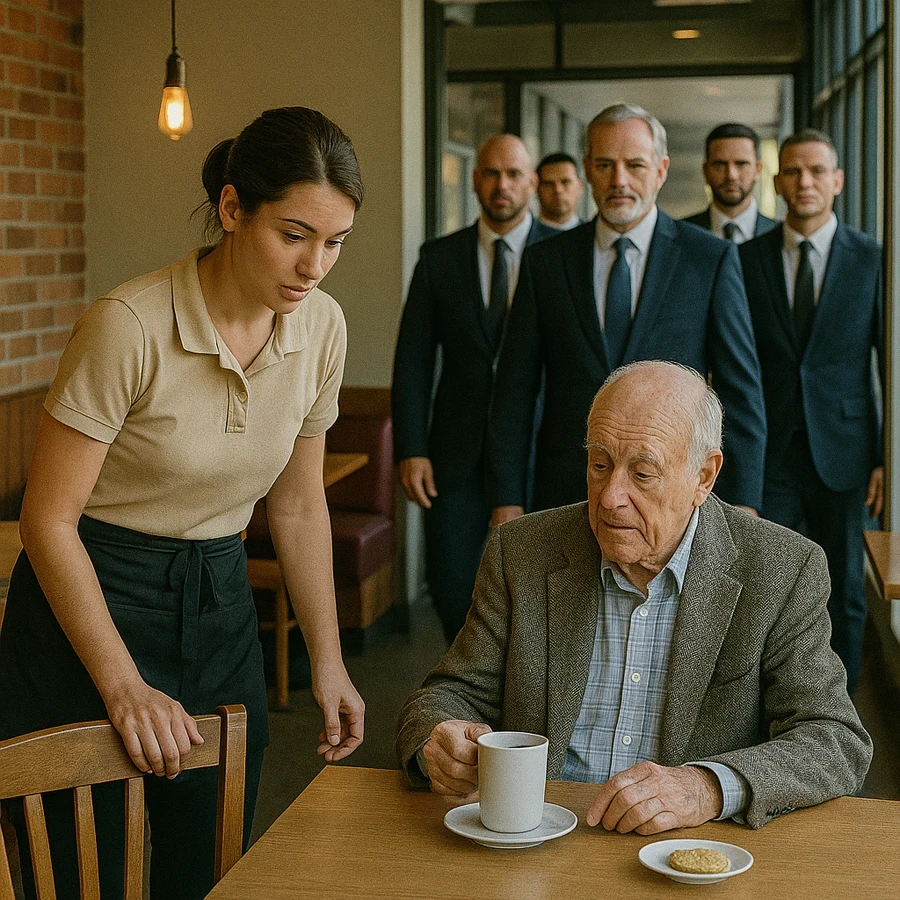
The diner bell chimed, and four men in black suits walked in. They weren’t the usual type who stopped by for pancakes and coffee.

Behind them, a man in his sixties, wearing an expensive coat, carried a leather briefcase. His presence commanded silence.

Every eye in the diner turned toward them.

“Can I help you?” Emma asked, uneasy but polite.

The man stepped forward. “Are you Miss Emma Carter?”

She hesitated. “Yes…”

He nodded. “I’m David Langford, attorney for the late Mr. Harold Benson.”

The words hit her like a gust of cold air.

“Late?” she whispered.

“I’m afraid Mr. Benson passed away three weeks ago,” Langford said gently. “He instructed us to contact you today.”

Her knees went weak. She gripped the counter. “I— I didn’t know. I’m so sorry…”

The lawyer gave her a small, sympathetic smile. “Mr. Benson spoke very highly of you, Miss Carter. He considered you a friend.”


The Letter

From his briefcase, Langford took out a sealed envelope and handed it to her.

It was heavy, cream-colored, and embossed with gold initials: H.B.

Emma’s hands trembled as she opened it. Inside, she found a letter written in neat, elegant handwriting.

“My dear Emma,”

If you are reading this, it means my time has come. Don’t be sad. I lived a long, full life — longer than I ever expected, considering the mistakes I made along the way.

You’ve been a light in my mornings for many years, though you never knew how much. You reminded me that kindness doesn’t have to be grand to matter — it can live in the smallest acts, like a refill of coffee and a smile on a rainy day.

There is something I’ve kept hidden for a long time — a truth I was too ashamed to face until now. You deserve to know it.

Ask Mr. Langford to show you what I’ve left behind. You’ll understand everything then.

With gratitude,
Harold Benson

Tears blurred her vision. The letter felt heavy — not just in her hands, but in her heart.


The Revelation

“Mr. Benson wanted you to accompany us,” Langford said quietly. “There’s something he asked us to deliver personally.”

The four bodyguards stood silently as Emma followed the lawyer outside. A black limousine waited at the curb.

The drive was long and silent, the city giving way to the countryside until they arrived at a gated estate.

It wasn’t a mansion — more of a manor, surrounded by fields and trees that looked older than time.

Inside, the air smelled faintly of cedar and old books.

Langford led her into a study. On the wall hung photos of Harold at different ages — younger, smiling, surrounded by people she didn’t recognize.

But one photograph caught her eye.

It was Harold, holding a newborn baby in his arms. His expression was full of joy… and sorrow.

“Who is this?” Emma asked.

Langford sighed. “That’s… his daughter.”

Emma’s heart sank. “He had a daughter?”

“Yes,” Langford said. “Her name was Grace Benson. She passed away thirty years ago.”

Emma’s voice trembled. “What happened to her?”

Langford looked down. “She died in an accident. But she left behind… a child.”

Emma froze. “A child?”

He nodded. “Mr. Benson’s granddaughter. She was placed in foster care. He searched for her for years, but the trail went cold.”

Emma’s hands shook. “Did he ever find her?”

Langford looked at her — and smiled faintly.
“He did.”


The Truth Comes Out

He handed her a folder. Inside was a birth certificate, a faded photo of a little girl with bright eyes, and a signature.

Her breath caught.

The name on the certificate read:

Grace Carter.

Emma felt the ground shift beneath her.
“That’s… that’s my mother’s name.”

Langford nodded. “And yours, Miss Carter. You are Harold Benson’s granddaughter.”

The room spun. Her mind raced back through every morning, every conversation, every knowing smile.

“He asked about my son…
He always called me ‘kiddo’…
He once said I reminded him of someone…”

Tears spilled down her cheeks. “He knew?”

Langford nodded softly. “He found you five years ago, but he didn’t want to intrude on your life. He wanted to know you — not as a long-lost relative, but as the kind, genuine woman you are.”

Emma covered her mouth. “All this time… he was family.”


The Gift

Langford gestured toward a wooden chest near the fireplace. “He left you this.”

Inside, Emma found several old journals, photographs, and a small box. In the box was a locket — gold, engraved with the initials “G.B.” Inside was a photo of a baby girl and a note:

“To my granddaughter, whom I love more than words. —Grandpa Harold.”

Alongside the box was a deed — a legal document transferring ownership of the entire estate to her name.

Emma stared in disbelief. “This… this can’t be real.”

“It is,” Langford said kindly. “He wanted you and your son to have a home. He said it was time to give back what life took away.”

She sank into the armchair, her tears falling freely now.

“All those mornings,” she whispered. “I thought he was just a lonely old man.”

Langford smiled faintly. “He was — until you came along.”


The Last Words

In one of the journals, Emma found Harold’s final entry, written just weeks before his passing.

“I see my daughter’s eyes in hers. I see hope, warmth, forgiveness — everything I lost years ago.

Emma doesn’t know she’s my blood, and maybe it’s better that way. She doesn’t treat me like a man with money or regret. She treats me like a person. That’s the greatest gift she could have given me.”

She closed the journal, her heart breaking and healing at the same time.


A New Beginning

Months later, Emma moved into the estate with her son. The diner became someone else’s to run, though she still visited sometimes, placing flowers by Table 5 — Harold’s table.

Her son, Liam, loved exploring the vast gardens, and Emma would sit by the window, watching him play, much like Harold once had.

Sometimes, when the morning sun hit just right, she could almost hear Harold’s voice again — warm, teasing, gentle:

“Two scrambled eggs, wheat toast, no butter, and coffee — black.”

And every time, she’d smile.

Because she knew he wasn’t gone.

He was there — in the laughter of her son, in the kindness she passed on to others, in the second chances life gives when you least expect them.


Epilogue: The Legacy of Kindness

Years later, when reporters asked Emma about the inheritance, the estate, and the incredible story of the waitress and the billionaire, she always gave the same answer:

“He didn’t give me money. He gave me something far more precious — the reminder that kindness never goes unnoticed, even when you think no one is watching.”

And perhaps that was Harold Benson’s final lesson — that in a world obsessed with wealth and success, the true legacy we leave behind is measured not by what we own, but by who we touch. ❤️
Related Articles

News 1 day ago

En la primavera de 1971, Lorine Deweiler gastó cuarenta y cinco dólares en 212 patos enfermos que nadie quería y los llevó a un terreno pantanoso que el condado llevaba treinta años intentando drenar sin éxito. Los vecinos se rieron, su familia creyó que estaba desperdiciando la herencia de su padre y los funcionarios aseguraron que una mujer sola nunca podría convertir barro en producción. Sin embargo, Lorine no había actuado por impulso: llevaba cuatro años estudiando el agua, la vegetación y los cuadernos secretos de su padre. Cuando llegó la crisis agrícola de los años ochenta, los mismos hombres que se burlaron perdieron tierras, maquinaria y hogares, mientras la mujer de los patos compraba granjas en efectivo y transformaba el terreno más despreciado del condado en el suelo más fértil de toda su propiedad.

  Part 2: Lorine utiliza investigación, paciencia y chatarra contra el pantano El costo total…

News 1 day ago

En 1971, Lorine Shrock gastó cuarenta y cinco dólares en once lotes de láminas de techo dobladas, oxidadas y rechazadas por un molino de Wisconsin, mientras todo el condado se reía de la mujer que había abandonado una beca universitaria para cuidar a su padre enfermo y trabajar una granja que nadie consideraba especial. Lo que sus vecinos creyeron una compra impulsiva era en realidad el primer paso de un plan calculado durante meses, basado en conocimientos de metalurgia aprendidos desde la infancia, herramientas completamente pagadas y un mercado olvidado entre comunidades que valoraban la duración más que la apariencia. Durante doce años, Lorine enderezó errores ajenos, convirtió basura industrial en material útil y acumuló dinero sin pedir un solo préstamo. Cuando la crisis agrícola arrasó cuarenta y una granjas del condado, la mujer ridiculizada apareció en una subasta, escribió un cheque personal por ciento quince mil dólares y obligó a todos a comprender que nunca habían estado observando a una granjera obstinada desperdiciar dinero, sino a una constructora silenciosa transformando aquello que el mercado no sabía valorar.

  Part 2: Las manos de su padre convierten errores industriales en material valioso Walter…

News 1 day ago

La mañana en que Riddle Creek se secó por completo, Martha Bell entró en el cauce con una pala mientras treinta y una vacas mugían de sed detrás del granero y sus vecinos se preparaban para verla perder la granja. Todos creían que aquella viuda de cincuenta y dos años estaba excavando una fantasía nacida del duelo, porque ningún banco valoraba un arroyo estacional y ningún hombre del pueblo recordaba agua bajo aquellas piedras. Pero Martha había encontrado musgo vivo, barro frío, un círculo de piedra y una nota escrita por su esposo muerto que mencionaba un secreto enterrado desde 1947. Lo que comenzó como una excavación ridiculizada terminaría salvando su ganado, protegiendo ciento cuarenta acres y revelando que la peor sequía en décadas no había destruido la verdad. Solo había eliminado suficiente tierra para que alguien paciente pudiera verla.

  Part 2: Un mapa de 1912 convierte una sospecha en una misión A la…

News 1 day ago

Cuando el banco declaró que treinta y una acres cubiertas de barro, sauces y juncos no tenían ningún valor, Nathan Klein arriesgó sus vacas, su maquinaria y el futuro de su familia para comprar la propiedad que todos evitaban. Los vecinos se burlaron mientras él se negaba a drenar completamente el pantano y construía un extraño sistema de canales, senderos y potreros alrededor del agua. Su primer año casi terminó en desastre, pero durante la peor sequía en tres décadas, aquella tierra despreciada se convirtió en el único pasto todavía vivo. Entonces el banco, los vecinos y hasta su propia hermana comprendieron que Nathan nunca había comprado un pantano: había comprado una fuente de supervivencia que nadie se había tomado el tiempo de entender.

  Part 2: Nathan se niega a destruir aquello que necesita comprender Durante el resto…

News 1 day ago

Cuando trescientas personas vieron una cadena de hierro tensarse entre un tractor John Deere de casi medio millón de dólares y una máquina de vapor construida en 1915, nadie dudó de cómo terminaría la competencia. Walter Hayes tenía setenta y tres años, una granja al borde de la ejecución hipotecaria y apenas cuarenta y cinco caballos de fuerza frente a seiscientos veinte. Su hija llevaba meses sin hablarle, el banco preparaba la orden que destruiría cuatro generaciones de trabajo y el joven propietario del tractor moderno necesitaba ganar para demostrarle a su padre que no había desperdiciado su vida. Pero Walter conocía la tierra, conocía su máquina y conservaba un secreto escrito por su padre junto a una válvula roja: úsala solamente cuando perder signifique perder quién eres.

  Part 2: Un padre distante, una hija ausente y una carta bancaria esperan A…

News 1 day ago

Trescientas personas acudieron a una feria rural de Tennessee convencidas de que presenciarían la humillación pública de un granjero anciano, endeudado y aferrado a una máquina de vapor construida en 1915. Frente a él esperaba un John Deere de casi medio millón de dólares, equipado con seiscientos veinte caballos de fuerza, sensores digitales y un joven propietario decidido a demostrarle a su padre que había elegido correctamente su vida. Nadie sabía que Walter Hayes estaba a pocos días de perder la granja de su familia, que su hija viajaba desde Chicago para reconciliarse con él ni que un secreto mecánico transmitido durante tres generaciones estaba a punto de convertir una competencia agrícola en una lección inolvidable sobre honor, conocimiento y promesas.

  Part 2: Seiscientos veinte caballos encuentran una resistencia inesperada Cuando la bandera descendió, el…

News 1 day ago

Durante seis años, Brandon Fletcher utilizó la pobreza, la enfermedad y el viejo tractor de Donald Mitchell como material de ventas, convenciendo a los agricultores de Iowa de que cualquier hombre que no comprara maquinaria nueva estaba condenado al fracaso. Entonces, frente a quinientas personas, desafió al granjero de setenta y cuatro años a competir contra un John Deere de casi medio millón de dólares. Nadie creía que un Farmall de 1952 pudiera sobrevivir, mucho menos ganar. Pero Donald conocía algo que Brandon jamás había aprendido en una sala de exhibición: la tierra no responde al precio de una máquina, sino al conocimiento de quien la trabaja. La apuesta terminaría destruyendo una reputación, salvando una granja y obligando a toda una comunidad a recordar lo que el progreso había hecho olvidar.

  Part 2: Una venta rechazada transforma la enfermedad en humillación pública En 2017, un…

News 1 day ago

Durante tres días, una excavadora de seiscientos mil dólares se hundió lentamente en un pantano de Iowa mientras ingenieros, grúas, excavadoras modernas y modelos informáticos fracasaban uno tras otro. Cuando un granjero de setenta y tres años llegó ofreciendo rescatarla con una máquina de vapor construida en 1912, el poderoso dueño de la constructora se rio delante de cuarenta trabajadores. Sin embargo, aquella reliquia familiar no solo arrancaría sesenta toneladas del barro; también destruiría la arrogancia de un empresario, cambiaría la educación de varios ingenieros y demostraría durante generaciones que algunas soluciones nunca quedan obsoletas: simplemente esperan a que alguien recuerde por qué fueron creadas.

  Part 2: Una máquina olvidada despierta para enfrentar lo imposible La Case de ciento…

News 1 day ago

Durante veintiséis años, Jonathan Wright fue ridiculizado por leer cada palabra antes de firmar cualquier contrato, mientras sus vecinos confiaban en apretones de manos, banqueros conocidos y cláusulas que nadie se molestaba en revisar. Cuando la crisis agrícola de 1983 llevó a un banco de Iowa a exigir el pago inmediato de catorce préstamos, trece familias descubrieron demasiado tarde que tres palabras escondidas en una página podían destruir generaciones de trabajo. Jonathan fue el único que se negó a inclinar la cabeza. Había preparado aquella defensa desde los dieciséis años, cuando vio a su padre perder ciento veinte acres por confiar en un amigo. Sin embargo, salvar su granja no lo convirtió en un hombre feliz: lo dejó rodeado de ruinas, aislado de sus vecinos y obligado a decidir si la prudencia que lo protegió también lo había condenado a vivir solo.

  Part 2: Un joven agricultor convierte la sala de un banco en su escuela.…

News 1 day ago

Un anciano cubierto de barro entró en un concesionario de maquinaria agrícola y pidió comprar doce tractores John Deere en efectivo, provocando las carcajadas del dueño, quien creyó estar frente a un granjero pobre y confundido. Minutos después, una llamada bancaria confirmó que aquel hombre tenía millones disponibles, pero el dinero era apenas la parte menos sorprendente de su historia. Detrás de sus botas desgastadas se escondían una infancia destruida por una ejecución hipotecaria, un hijo enterrado demasiado pronto, una esposa moribunda y una promesa capaz de transformar el futuro de decenas de familias agrícolas durante generaciones.

  Part 2: Una infancia destruida convierte el dolor en propósito Kenneth nació en Marshalltown…