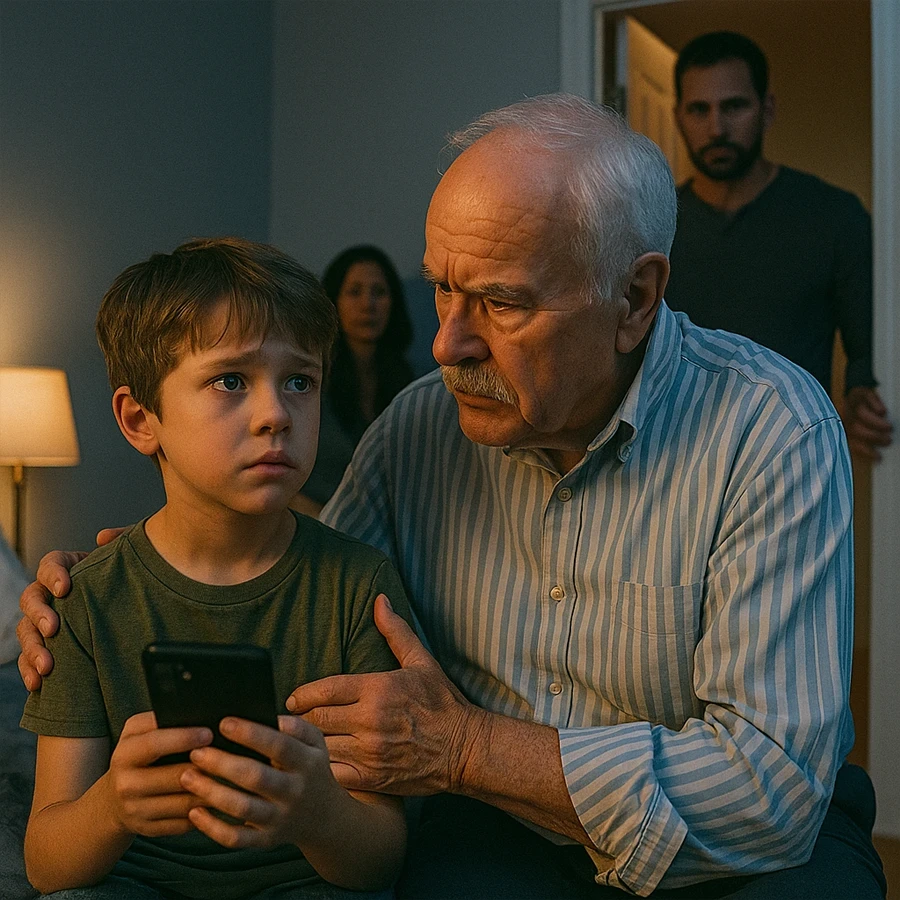
The Night My Grandson Whispered, “Grandpa, I’m So Hungry, He Locked Me In,” and How One Desperate Phone Call Forced Me to Choose Between Keeping the Peace and Saving a Child I Loved More Than My Own Pride
The Night My Grandson Whispered, “Grandpa, I’m So Hungry, He Locked Me In,” and How One Desperate Phone Call Forced Me to Choose Between Keeping the Peace and Saving a Child I Loved More Than My Own Pride
I was halfway through some late-night baseball highlights when my phone lit up on the coffee table.
At first, I thought it would be one of those scam calls—“Your car warranty is about to expire”—the usual junk. But then I saw the name on the screen and my stomach tightened.
Liam (Cell)
My seven-year-old grandson wasn’t supposed to have his own phone. The number was from an old smartphone my daughter had said she kept in a drawer for emergencies.
It was 10:42 p.m.
I picked up immediately.
—Hey, buddy, you’re up late —I said, trying to sound light.
What I heard on the other end wasn’t a seven-year-old staying up past bedtime.
It was a tiny, shaky whisper.
—Grandpa?
—Yeah, it’s Grandpa. What’s going on, kiddo?
There was a pause. I heard breathing. I heard… something else. A creak, maybe. And then, very quietly:
—I’m so hungry.
I sat up straighter on the couch.
—Hungry? Didn’t you have dinner?
Another pause.
—He forgot to give me dinner —Liam said—. He said I was being bad. He locked me in.
My heart stopped.
—Locked you in where? —I asked, my voice dropping. I reached for the remote, turned off the TV, and held the phone tighter against my ear.
—In the closet —he whispered—. I’m not supposed to have the phone. I found it in my backpack. I’m really hungry, Grandpa.
I stood up without thinking. My knees cracked in protest, but I barely felt it.
—Okay, listen to me, champ —I said, forcing myself to sound calm—. Are you alone?
—He’s downstairs. He was yelling on the phone. I think he left. The house is quiet now.
“He.”
I knew exactly who that was.
Nathan. My daughter’s husband. My grandson’s stepfather.
My mind started racing through every little moment from the past year that suddenly felt a lot less “little”: the time Liam flinched when Nathan raised his voice at a football game on TV. The time my daughter, Megan, brushed off a bruise on Liam’s arm with, “He’s just clumsy, Dad. He runs into everything.”
I had wanted to believe her.
I didn’t want to be “that” grandparent—the one always questioning parental decisions, always stirring up drama.
—Grandpa? —Liam whispered again—. Are you still there?
—I’m right here —I said—. I’m not going anywhere. Do you know where your mom is?
—She’s working. She said she had a late shift —he answered. I heard the tiny rustle of him moving in the dark—. I don’t like it here when she’s not home.
—Okay, buddy. You’re so brave for calling me. I’m really proud of you.
My voice felt too steady for what was happening inside me. I grabbed my truck keys from the hook by the front door and shoved my feet into my shoes. My hands were shaking so badly I almost dropped the keys.
—Liam, can you tell me… are you hurt? Did he hurt you?
There was a silence that lasted way too long for a yes or no question.
—He… pushed me —Liam finally said—. I fell. But I’m okay. I just want to get out. It’s dark, Grandpa.
I stopped at the door, my hand on the knob, and swallowed hard.
—Okay. How about you stay on the phone with me? Don’t hang up, all right?
—Okay.
—I’m going to call someone to help, and then I’m coming to see you. But first, can you tell me: is the door locked with a key? Or can you open it from the inside?
—I tried —he answered, voice getting shaky—. The handle doesn’t move. He put something in it.
A lump formed in my throat. I closed my eyes for a second, fighting down the anger that was building like a storm.
—All right —I said—. You did exactly the right thing, calling me. You’re not alone, Liam. I promise you that. I’m going to put you on hold for just a second, okay? Don’t be scared. I’ll be right back.
A tiny sniffle.
—Okay. Please don’t forget me.
Those words nearly broke me.
—I will not forget you, kiddo. Not ever. I’m coming.
I pulled the phone away from my ear just enough to hit the “add call” button and dialed 911.
The operator picked up fast.
—911, what’s your emergency?
I spoke quickly, trying not to sound frantic, but there was no hiding the urgency in my voice.
—My seven-year-old grandson just called me. He says he’s locked in a closet at his house and hasn’t had dinner. His stepfather did it. I don’t know if the man is still there.
She asked for the address, my name, my relationship to the child. I gave her everything. Street name. House number. My grandson’s name. My daughter’s name. Every detail that might buy us a few seconds less delay.
—Officers are on their way —she said—. Stay on the line with him if you can. And don’t go inside if you get there before the officers. Your safety matters too.
I wanted to tell her that I didn’t care about my safety, but I knew arguing wouldn’t help.
—Yes, ma’am —I managed.
As soon as I merged the calls, Liam’s whisper came back.
—Grandpa?
—I’m here. I called some helpers to come make sure you’re okay. They’re on the way to your house.
—Am I in trouble?
That question. So small, so heavy.
—No, Liam. You are not in trouble. You did the right thing.
—I don’t want Mom to be mad —he said, voice cracking.
I took a breath.
—If your mom gets mad at anyone, it shouldn’t be you. But we’ll talk about that later. Right now, I want you to tell me: can you feel anything in the closet? A coat, a box? Anything you can sit on so you’re more comfortable?
—I’m sitting on my backpack —he said, sniffing again—. It smells like school.
—Good. That’s perfect. It’s like camping, remember?
He gave a weak little laugh.
—Camping doesn’t smell like shoes.
—True —I said—. Okay, you know what I want you to do? I want you to focus on my voice. I’m going to tell you a story, and you’re going to imagine it in your head until you hear a knock on the door from the police, alright?
—Okay.
So I did what I’d done since he was a toddler. I told him a story.
I told him about a brave knight named Liam who was stuck in a secret tower, guarded by a mean dragon who couldn’t handle how strong and smart the knight was. And how the knight’s grandpa, the old captain, called in a whole team of good dragons to help rescue him.
I made up the details as I drove, one hand on the steering wheel, the other gripping the phone like a lifeline. Every time my voice shook, I swallowed hard and kept going.
I ran a red light on Maple Street. I didn’t even see it until it was in my rearview mirror.
I reached their neighborhood in just under fifteen minutes.
The flashing red and blue lights got there about thirty seconds before I did.
Liam and Megan lived in a small two-story house on a corner lot in a quiet suburb—neatly cut grass, a tire swing out front, a wreath on the door that changed with the seasons. From the outside, it was the kind of house you’d expect to see on a greeting card.
As I pulled up to the curb, two police cars were already there. A third was just arriving. A couple of neighbors had come outside, standing on their porches, arms folded, wearing that mix of concern and curiosity I’d seen a hundred times before in other people’s stories—but never my own.
I put my truck in park and practically jumped out. For a second, I forgot the operator’s words about my safety.
One of the officers spotted me before I could get to the front door.
—Sir, stay back for a moment —he said, stepping towards me with one hand raised in a calming gesture—. Are you the one who called?
—I’m the grandfather —I said—. His name is Liam. He’s seven. He’s in there, and he’s locked in a closet. I need to—
—We’re going to get him, sir —the officer said firmly—. But you need to stay out here until we secure the scene.
“Secure the scene.”
This wasn’t some crime show. This was my grandson. In a closet. In the dark.
I clenched my jaw, nodded once, and stayed where I was, my fists clenched at my sides, my phone still pressed to my ear.
—Liam? —I said softly—. Do you hear anything outside? Sirens?
On the other side, I heard him suck in a breath.
—I hear… something. Like a car… and talking.
—Those are the helpers I told you about —I said—. They’re there to get you out. Just keep sitting tight.
The officers knocked, called out, and then used some kind of tool on the lock. It didn’t take long. Less than a minute.
The front door swung open, and the two officers went inside.
From where I stood, I could only see the entryway. Hallway. Staircase to the right. Living room straight ahead. It looked like every time I’d ever been there—only emptier.
No Nathan.
One of the neighbors, a woman in a housecoat with her hair up in a clip, shuffled up a little closer to me.
—Is everything all right, Mr. Walters? —she asked. I recognized her; she lived across the street. They’d waved at me a few times when I visited.
—We’ll see —I muttered.
Then I heard it.
A shout from inside the house.
—We got him! He’s here!
My whole body sagged with relief.
A few moments later, an officer appeared at the doorway, carrying a boy in his arms. Liam’s arms were looped around his neck, and his face was buried against the officer’s chest, but I recognized the mop of light brown hair instantly.
—Liam! —I called, my voice cracking.
His head snapped up.
—Grandpa!
The officer set him down carefully and kept a hand on his shoulder as they stepped out onto the porch.
I moved forward, forgetting any rule they might have had about distance.
And then he was in my arms, small and shaking, his fingers clutching my jacket with surprising strength.
He smelled like dust and stale air and the faintest hint of peanut butter.
—You came —he whispered.
—Of course I came —I said into his hair—. I’ll always come when you call me. Always.
I felt him tremble against me.
He was thinner than I remembered.
Back inside, the officers did a quick search of the house. They checked every room, every closet, the backyard. Nathan was nowhere to be found.
—Looks like he took off —one of them said when he came back outside—. We’ll put out a notice for him. Is your daughter at work?
—Yeah —I said—. She works the late shift at the hospital. I’ve tried calling, but she’s not picking up yet.
—We’ll keep trying from our end too —the officer said—. In the meantime, we’re going to need to ask your grandson a few questions, and we’ll need you to stick around. Child Protective Services will be on their way as well.
I swallowed.
—You’re not going to send him back… here… tonight, are you?
The officer shook his head.
—Not tonight. For now, he’ll either stay with you or in emergency care, depending on what CPS decides. Do you have room for him at your place, sir?
I looked down at Liam, still holding onto my hand like it was the last solid thing in the world.
—I have room —I said.
I had more than room. I had a whole house with empty bedrooms and quiet halls that had been feeling too big for one old man.
While the officers took notes and waiting for CPS, they let me sit with Liam on the front steps, wrapped in one of the blankets they kept in the trunk of their car.
He told them about being sent to the closet after he “talked back.”
—What did you say? —the CPS worker, a woman named Patricia, asked gently.
—He said I was too slow doing my homework —Liam mumbled—. I told him I was trying. He said that was a lazy answer. I said, “You’re being mean.” He got really mad.
His eyes darted toward me, like he expected to get in trouble for even repeating it.
—And this isn’t the first time this has happened? —Patricia asked.
Liam shook his head, staring at his sneakers.
—He locks me in when I make him mad —he said quietly—. Sometimes just for a little while. He says it’s so I can “think about it.” But tonight… tonight he forgot about me. I think he went out. I heard the door slam. I was really hungry.
Patricia’s face didn’t change much, but I saw her jaw tighten.
—Thank you for telling me that, Liam —she said—. You did something very brave by calling your grandpa. That’s not easy to do.
—Am I… going to get him in trouble? —Liam asked.
—He got himself in trouble —I said before Patricia could answer—. You just told the truth.
She glanced at me, then nodded.
—Your grandpa is right —she said—. You are not responsible for what grown-ups choose to do.
That was the night everything shifted.
Sometimes you can feel the exact moment your life splits into “before” and “after.”
For me, it was sitting on the front steps of my daughter’s house, holding my grandson’s hand under a thin blanket, surrounded by flashing lights and neighbors pretending not to stare.
Megan arrived about forty minutes later, still in her scrubs, her hair pulled back in a messy bun, her ID badge swinging as she rushed from her car to the driveway.
—What happened? —she demanded, looking from the police cars to Liam to me—. Dad? Why are there officers here? What’s going on?
Liam’s grip on my hand tightened.
Patricia stepped forward, introduced herself, and began to explain in calm, measured tones. Megan’s face went from confusion to disbelief to anger so quickly it made my head spin.
—He locked him in a closet? —she repeated, almost laughing, but with no humor in it—. That doesn’t make any sense. Nathan would never—
—He did —Liam said suddenly, his voice small but firm.
Megan turned to him, stunned.
—Sweetie… maybe you misunderstood —she said—. Nathan can be strict, I know that, but—
—He put me in there —Liam interrupted, tears filling his eyes—. He put the chair under the handle. He said if I cried, nobody would hear me. He said Mom would be mad at me if she had to come home early again.
Megan’s face crumpled.
She looked at me, then at Patricia, then at the officers, and finally back at her son.
—Liam… why… why didn’t you tell me? —she asked, her voice breaking—. Why didn’t you say anything before?
He looked down at his shoes.
—He said you needed him. That you’d be sad if he got in trouble. He said… He said you already thought I was hard to handle. I didn’t want you to hate me.
That was it.
I saw something break inside my daughter’s eyes—a dam, a shell, whatever she’d been holding onto to keep herself from seeing what she didn’t want to see.
She moved quickly then, dropping to her knees in front of him and cupping his face in both hands.
—Hey. Hey. Look at me —she said, tears running down her cheeks—. I could never hate you. Do you hear me? Never. You’re my son. You are the best thing that’s ever happened to me.
He hesitated, then met her gaze.
—Even when I’m slow with my homework?
She let out a shaky laugh.
—Especially then —she said—. Homework is the worst.
He gave the tiniest smile.
Megan pulled him into a hug, her arms tight, almost desperate.
Over his shoulder, her eyes found mine.
There was apology there. And guilt. And a silent question: How did I let this happen?
I didn’t have an answer for her. I had been there, after all, on the edges of their life, watching things that didn’t feel right and telling myself it wasn’t my place to interfere.
Patricia gave Megan a few minutes with Liam, then gently explained the process ahead. Reports. Temporary arrangements. Safety plans. Possibly a restraining order against Nathan.
—For tonight, he’s going with his grandfather —Patricia said—. You’ll have visitation, but we need a bit of distance while we sort this out.
Megan nodded, wiping at her eyes.
—I’ll sign whatever you need —she said—. Just don’t take him away completely.
Patricia shook her head.
—The goal is safety, not punishment —she said—. We just need to make sure this doesn’t happen again.
When we left, Liam’s hand was in mine, and Megan walked us to my truck, her eyes red but her jaw set.
—Dad —she said quietly, as Liam climbed into the passenger seat—. Thank you for coming.
It was such a simple sentence. But I heard the rest of it in the silence.
Thank you for believing him. Thank you for believing what I didn’t want to see. Thank you for letting him call you.
I nodded.
—Always.
We didn’t talk much on the drive back to my place. Liam held the blanket around his shoulders and watched the passing streetlights, his eyes heavy but still open.
—Grandpa? —he said after a few minutes.
—Yeah, buddy?
—Is he going to be mad?
I knew who “he” was.
—I don’t know —I answered honestly—. But if he is, that’s something for the grown-ups to deal with. You’re not responsible for his feelings. You’re responsible for telling the truth. And you did that.
—I don’t want to go back there —he said.
—I know —I replied—. And right now, you’re not going to. You’re coming home with me.
He leaned his head against the window, his voice barely above a whisper.
—I like your house. It smells like pancakes.
I laughed softly.
—Then pancakes it is for breakfast.
He was asleep before we reached my street.
If you’ve never suddenly become responsible for a scared child in the middle of the night, I can tell you this: your brain turns into a checklist machine.
Clean sheets. Nightlight. Extra toothbrush. Does he have pajamas? Does he have anything from home? When is school? Who do we need to call in the morning?
But beneath the practical questions, there was a deeper, heavier one:
What now?
I tucked Liam into the guest room—the one that still had old posters from when my own kids were teenagers—and found one of my old t-shirts for him to sleep in. It hung off his shoulders, almost down to his knees.
He looked very small in that bed.
Before I turned off the light, he looked up at me.
—Grandpa?
—Yeah?
—Are you going to lock the door?
The question blindsided me.
—No, buddy —I said quickly—. I will never lock you in a room. Ever.
—If I’m loud? —he asked, eyes serious.
—If you’re loud, I’ll tell you to quiet down —I said—. Or I’ll be loud with you. But I won’t lock you away. Not for being yourself.
He thought about that, then nodded.
—Okay.
I stood in the doorway for a long time after I turned off the light, listening to his breathing. The shadows in the room were just shadows, but every time one shifted, I felt an urge to go check on him again.
That night, I didn’t sleep much.
Every time I closed my eyes, I saw a closet door.
The weeks that followed were a blur of paperwork, meetings, and low-grade anxiety humming underneath everything.
There were calls with Patricia and other CPS workers. Interviews with officers. Appointments with a counselor for Liam, where he got to talk about what happened in a safe, gentle way, using drawings and games.
There were also hard conversations with Megan.
She stayed with Nathan for about a week after that night, trying to “talk it through,” trying to understand, trying to fix something that, in my opinion, didn’t deserve fixing.
I kept my temper in check, for Liam’s sake. But it wasn’t easy.
—How do you “talk through” someone locking your kid in a closet? —I asked her one afternoon, trying not to raise my voice, but failing a little.
We were sitting at my kitchen table. Liam was in the living room, building some elaborate tower with the set of blocks I’d bought him.
—He… said it wasn’t like that —Megan replied, rubbing her temples—. He says he just meant to give him a “time-out,” and then he got distracted and went out to calm down, and he forgot. He swears it was a mistake.
—You believe that? —I asked quietly.
She looked helpless.
—I don’t know what to believe —she admitted—. I know what Liam said. I know what you heard. I know what the police report says. But I also know the man I thought I married. He’s never laid a hand on me.
—That doesn’t make him safe for your son —I said—. We don’t always get the same version of a person. Kids get one version. Partners get another. Outsiders get another.
She wiped her eyes.
—I feel like an idiot —she said—. A blind idiot.
—You’re not an idiot —I said gently—. You’re someone who wanted to believe the best about the person you loved. That’s not foolish. But now you know better.
She stared into her coffee cup.
—Liam needs me to choose him —she whispered.
—He does —I said.
She looked up at me then, and for the first time since this whole mess started, I saw a steel in her eyes I recognized from years ago—back when she was a stubborn eighteen-year-old telling me she was keeping the baby, no matter what her boyfriend said.
A week later, she moved out of the house.
She found a small apartment closer to her work and Liam’s school. At first, Liam split his time between my place and hers, always with some kind of supervision in place while the case remained open.
Nathan tried to reach out.
He called. He texted. He sent long emails.
He claimed he made a horrible mistake.
He said he’d grown up with strict discipline and thought that was normal.
He said he loved Liam like his own.
He said he felt ashamed.
I read some of the messages over Megan’s shoulder.
—Do you think he means it? —she asked.
—I think a man’s true character shows in the dark —I said—. Literally and figuratively. When no one’s watching, what does he do? In that house, in that moment, his choice was to lock a hungry child in a closet. That’s who he is, whatever he writes now.
In the end, the court issued a protection order. No contact with Liam unless approved and supervised, and even then, only after a long period and a lot of work. Nathan moved out of state a few months later, supposedly to be near his own family.
I didn’t lose any sleep over it.
What people don’t talk about enough is what comes after.
After the rescue.
After the police.
After the dramatic phone call in the night.
Life doesn’t magically reset itself to “normal.” There’s a long, quiet road of healing that nobody makes movies about.
Sometimes the hardest part isn’t the night everything went wrong.
It’s the mornings after.
The mornings when your grandson wakes up in a safe bed in a safe house… but still flinches when the door closes a little too quickly.
The afternoons when he panics because you stepped outside to get the mail and didn’t tell him.
The nights when he stands in your bedroom doorway, clutching a pillow, and asks, in a voice too small for his age:
—Can I sleep in here? Just this once?
You say yes.
As many times as he needs it.
You also learn that healing doesn’t just belong to the child.
It belongs to the adults who failed him, too.
Megan started therapy, not just for Liam, but for herself. She dug through the mess of her own past, her own patterns, her own blind spots. She admitted things she didn’t want to admit: how lonely she’d been, how scared she was of being a single mom again, how much she had wanted Nathan to be the answer to problems he was never equipped to solve.
She apologized to Liam. Not once. Not dramatically. But regularly, in small, sincere ways.
—I’m sorry I didn’t see it sooner —she told him one night while I was washing dishes and listening from the kitchen doorway—. I’m sorry I didn’t protect you like I should have. That was my job. I’m going to do better.
Liam was coloring at the table, a superhero with a bright red cape.
He didn’t look up when he answered.
—You’re doing better now —he said simply.
Sometimes kids say things with a clarity adults spend years trying to find.
About six months after that night, I got called into a meeting at Liam’s school.
Parent-teacher conferences. Nothing unusual. But still, I felt the faint flutter of worry I always did now whenever a school number popped up on my phone.
The teacher, a young woman named Ms. Carter, smiled as we sat down at the little round table.
—Thank you for coming, Mr. Walters —she said.
—He’s been staying with me a lot this year —I explained—. His mother’s working on changing her schedule, but for now, I do some of the pickups and drop-offs.
—We appreciate you being so involved —she said—. Actually… what I wanted to talk to you about wasn’t exactly about academics.
My back stiffened.
—Is he… okay? —I asked.
She nodded.
—He’s doing much better —she said—. At the beginning of the year, he was very quiet. Flinched at loud noises. Avoided group activities. But lately, he’s started participating more. He’s raising his hand. He reads aloud now. And yesterday, he did something I wanted to make sure you knew about.
She flipped open a folder and pulled out a drawing.
It was a house. Not the one he used to live in—this one had a big tree next to it and a truck in the driveway. A little figure with a shock of brown hair stood next to an older man with a beard.
“That’s us,” I thought.
At the top of the paper, in careful, uneven letters, he’d written:
“THE SAFE HOUSE”
Ms. Carter smiled.
—I asked him to tell me about his picture —she said—. He said, “That’s my grandpa’s house. It’s the safe house.” I asked him what made it safe, and he said, “Because there are pancakes and nobody locks the doors.”
I blinked hard, my throat suddenly tight.
—He… said that? —I managed.
—He did —she said gently—. I just wanted you to know that whatever you and his mom are doing… it’s working. He feels secure here. That’s a huge step.
I cleared my throat and nodded.
—Thank you —I said—. That means a lot.
On the drive home, Liam chattered about a science experiment they’d done in class that involved baking soda and vinegar. I listened, smiling, glancing at him in the rearview mirror.
—Hey, kiddo —I said when we pulled into the driveway—. You want to help me make pancakes for dinner?
He lit up.
—For dinner?
—Sure —I said—. Why should breakfast have all the fun?
He laughed, that bright, genuine laugh kids have when they’re not worried about the next thing that might go wrong.
In the kitchen, while we mixed batter and spilled flour everywhere, he looked up at me with that serious look he got when he was thinking hard.
—Grandpa?
—Yeah?
—That night… when I called you… what if you hadn’t picked up?
The question knocked the air out of me for a second.
—I would have picked up —I said—. One way or another. I would have kept calling back if I missed it.
He nodded slowly.
—I was really scared —he admitted—. My hands were shaking. I almost didn’t call. I thought… maybe you’d be asleep.
—I’m really glad you did call —I said—. You saved yourself that night, you know that? I came to help, but you were the one who chose to reach out.
—I just didn’t want to be alone in there anymore —he said quietly.
I set down the whisk and put a hand on his shoulder.
—You’re not alone —I told him—. Not now. Not ever. If you’re scared, if something’s wrong, you call me. I don’t care if it’s day or night, if I’m asleep or watching a game or halfway through a nap. You call. I’ll pick up.
He smiled a little.
—I know —he said—. You’re the captain of the dragons.
I chuckled.
—The what?
—From your story —he explained—. The night you told me the story about the knight in the tower. You said the grandpa was the dragon captain. I liked that.
Funny how the stories you make up to get a scared kid through a bad night can stick with them long after the fear has faded.
—Then as captain of the dragons —I said solemnly—. I hereby promise to always answer when my favorite knight calls.
He giggled.
—I’m your only knight.
—That’s why you’re my favorite —I said.
A year after that night, almost to the day, Megan organized a small barbecue in the backyard of her new apartment complex. No big celebration, no speeches. Just family, a couple of close friends, and too much food, the way we like it.
Liam was taller. His cheeks a little fuller. His laughter louder and easier.
He ran around the yard with a group of kids from the building, playing tag, climbing on the little play structure, yelling instructions in a way that would have been impossible for the quiet, cautious boy from a year ago.
At one point, he trotted over to the picnic table where I was sitting, grabbed a bottle of water, and took a big gulp.
—Grandpa! —he said between breaths—. Can I show them your dragon captain voice later?
I raised an eyebrow.
—My what?
—You know, when you read my stories and you make the dragon say stuff —he said—. It’s funny. I told my friends about it. They want to hear.
—Sure —I said, amused—. I’ll make sure I warm up my dragon voice.
He grinned and ran off again.
Megan sat down next to me, setting a plate loaded with food on the table.
—He looks good —I said, watching him.
—He is good —she answered—. He has nightmares sometimes. But fewer than before. He talks more in therapy. He’s… lighter.
She took a breath.
—Dad?
—Yeah?
—I don’t think I’ve actually said this out loud —she began—. Not really. Not fully.
She looked at me, her eyes bright but steady.
—Thank you for that night. Not just for going… but for listening. For believing him. For not telling him to “stop exaggerating” or “respect his stepfather” or any of that. If you hadn’t taken him seriously…
She didn’t finish the sentence. She didn’t have to.
—I didn’t do anything special —I said quietly—. I answered the phone.
She shook her head.
—You did more than that —she said—. You answered the call that I should have heard long before he dialed your number.
I reached over and squeezed her hand.
—We all did the best we knew how with what we had —I said—. When we knew better, we did better. That’s all anyone can ask.
She gave a small, grateful smile.
—You really are the dragon captain —she said.
I laughed.
—That’s what he calls me.
—it fits —she said.
As the sun dipped lower and the yard filled with the sounds of kids playing and adults talking and someone completely burning a batch of hot dogs, I sat back in my chair and let the moment wash over me.
A year ago, a terrified little voice had whispered into the dark, telling me he was hungry and locked away, scared and forgotten.
Now that same boy was running across the grass, shouting orders to imaginary knights, his hair flying in the breeze, his sneakers kicking up dirt, his laughter echoing off the walls of a place he knew was safe.
The phone call that night had forced me to choose between keeping the peace and protecting a child.
It wasn’t a perfect process. I hesitated more times than I like to admit. I worried about overreacting. I worried about breaking my daughter’s trust.
But in the end, the choice became simple.
You pick the kid.
Every time.
Because you never know when a scared seven-year-old, sitting in the dark with an empty stomach and a pounding heart, is going to reach for whatever hope he can find.
And sometimes, that hope is just one phone call away.
THE END