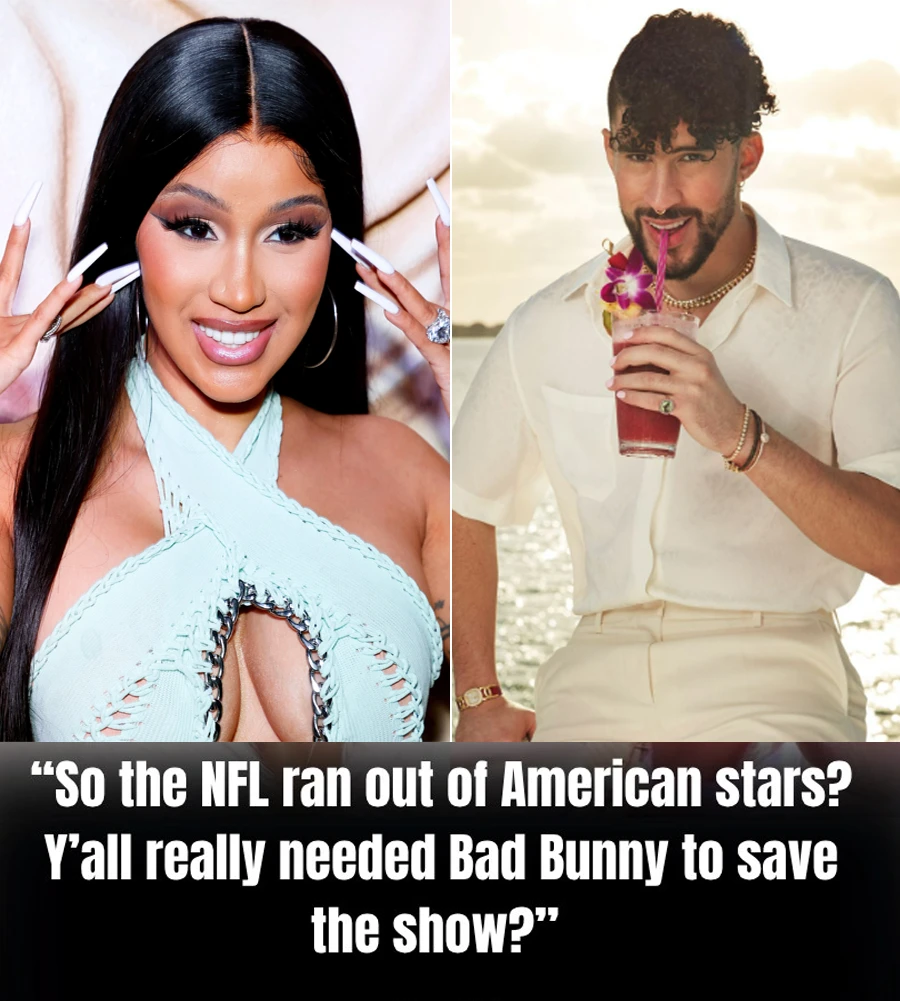
When the NFL Stirs the Pot: Bad Bunny, Cardi B, and the Halftime Show Backlash – News

When the NFL Stirs the Pot: Bad Bunny, Cardi B, an...

When the NFL Stirs the Pot: Bad Bunny, Cardi B, and the Halftime Show Backlash

“Cardi B Blasts NFL’s Surprise Choice: ‘Ain’t There American Singers?’ Bad Bunny to Headline Halftime — Shocking Move or Bold Statement?”

In a move that’s already sending shockwaves across the music, sports, and cultural world, the NFL has officially confirmed that Bad Bunny, the Puerto Rican phenomenon adored by millions globally, will headline the Super Bowl LX halftime show in Los Angeles. Shortly after the announcement, Cardi B erupted with sharp criticism, asking pointedly: “Ain’t America got singers of its own?” The drama is only beginning — and it forces us to ask: is this a celebration of inclusion and cross-cultural power — or a spectacle meant to provoke and polarize?

The Announcement That Shook the Field

On a recent Sunday night broadcast, during “Sunday Night Football,” the NFL — in partnership with Apple Music and Roc Nation — unveiled its pick for the 2026 halftime headliner: Bad Bunny. Reuters+2New York Magazine+2 In his response, Bad Bunny dedicated the moment to his heritage, his fans, and especially the Latino community: “This is for my people, my culture, and our history.” New York Magazine+2Reuters+2 He pledged that the performance would be memorable, bold, and deeply rooted in identity.

But in the wake of the announcement came a cascade of reactions — praise, backlash, confusion. Among the loudest voices was Cardi B, who fired off remarks questioning the choice, hinting at a deeper frustration that U.S. talent seemed overlooked. Her words instantly lit a firestorm of debate.


Cardi B’s Outburst: What’s Behind It?

By all accounts, Cardi B’s reaction was blunt and emotionally charged. Her question — “Ain’t America got singers of its own?” — struck a nerve: was she protesting perceived favoritism toward a Latin artist, or voicing frustration over what she saw as sidelining U.S.-born performers?

Publicly, she framed it as a matter of fairness. But beneath the headline, one can detect layers of tension:

Territorial pride vs. global influence: Many U.S. artists see the Super Bowl halftime as a pinnacle platform — a way to cement legacy. Cardi’s outburst can be read as frustration that that platform is being given to someone she sees as an “outsider,” despite Puerto Rico’s political and cultural ties to the U.S.

Race, identity, and belonging: The controversy inevitably drags issues of nationality, language, and belonging into the spotlight. Some felt she was questioning Bad Bunny’s “Americanness” — a line that’s fraught given that Puerto Ricans are U.S. citizens.

Industry politics and ego: In entertainment, choices like this carry high stakes — exposure, brand alignment, contracts. Cardi’s reaction might also reflect deeper artist tensions, perceived slights, or a sense that major decisions are being made behind closed doors.

Whatever her motives, Cardi’s words resonate precisely because they tap into an age-old question: who gets to represent “America” on its biggest stages?


The NFL’s Calculated Gamble?

At first glance, the NFL’s pick of Bad Bunny appears bold, even risky. The league has often been criticized for playing it safe with halftime acts — favoring established pop stars that appeal broadly. This move breaks that mold.

Observers point to several possible motivations behind this decision:

Expanding audience reach: The NFL is aware of shifting demographics. Latinx audiences represent massive viewership potential. By tapping into one of the most powerful Latin artists in the world, the league could be signaling an intentional shift toward greater cultural relevance. Reuters+3New York Magazine+3ABC+3

Global hype and buzz: Bad Bunny’s name commands international attention. The announcement guarantees headlines, controversy, and discussion — all valuable in the attention economy.

Artistic authenticity over safe choice: In recent years, halftime performances have dipped into social commentary, symbolism, and meaningful statements (see Kendrick Lamar’s powerful political set in 2024). The NFL may be embracing a more daring direction. New York Magazine

Still, this is a gamble. Many longtime fans expected a mainstream American pop icon, and some feel the choice will alienate segments of the traditional audience.


The Storm of Backlash

The announcement triggered criticism, confusion, and pushback from various camps.

1. Questions of “American-ness”

Some critics — possibly influenced by political narratives — questioned whether Bad Bunny could be called an “American artist.” In doing so, they appeared to ignore the fact that Puerto Ricans are U.S. citizens, a fact often overlooked or deliberately ignored in public discourse. Reuters+3New York Magazine+3ABC+3 This misperception became a flashpoint for debates about belonging, identity, and erasure.

2. Political firestorms

The decision ignited conservative backlash. Some accused the NFL of promoting “woke culture” or of using the platform for identity politics rather than pure entertainment. New York Magazine+3WIRED+3Reuters+3 Others attacked Bad Bunny’s political stances, noting that he has criticized immigration enforcement and supported progressive causes. Guardian+3New York Magazine+3Le Monde.fr+3

Even more provocative: some officials openly suggested the presence of ICE (Immigration and Customs Enforcement) at the event. EW.com+2Guardian+2 That threat alone felt like weaponizing the spectacle toward political ends — turning a halftime show into a battleground over who is “allowed” to attend.

3. Fanbase divisions

Among fans, reactions split. Some embraced the move enthusiastically — proud to see Latin representation on that stage. Others felt disappointed or betrayed, believing a U.S. mainstream artist would have been more appropriate. The division mirrors larger cultural tensions playing out in playlists, politics, and social media.


Bad Bunny’s Response — Grace Under Fire

Despite the maelstrom, Bad Bunny has responded with poise.

In his “Saturday Night Live” monologue following the announcement, he leaned into humor, pride, and cultural identity. He gently challenged critics — saying non-Spanish speakers have a few months to learn. New York Magazine+3Guardian+3Le Monde.fr+3 He emphasized that Puerto Rico is U.S. territory, and that representation from his community is not a concession but a necessity.

He spoke of carrying ancestral weight — that his performance is not just for him, but for those who paved the way. New York Magazine+2Reuters+2 In short: he centered the narrative on heritage, pride, and artistic voice — refusing to be boxed or diminished.


The Stakes: More Than Just a Show

At first glance this is entertainment. But the stakes are cultural, political, and symbolic.

Representation matters: When a Latin artist headlines arguably America’s biggest live broadcast, it transforms how millions see themselves and what gets centered in the national gaze.

Shifting definitions of American identity: This controversy forces us to reckon with who counts as “American.” Is it just those born on the mainland? Do language, race, or heritage play a role?

Commercial strategy meets culture: The NFL’s move is as much a business decision as an artistic one. It signals the league’s awareness that it must evolve or risk irrelevance in a globalized, diverse media landscape.


So … Is the NFL Celebrating Diversity, or Is It a Stunt?

The honest answer: it may be both.

From one perspective, the NFL is seizing a moment to expand its narrative — to include voices long marginalized on these massive stages. That is a meaningful shift, and one overdue.

From another perspective, the timing, the spectacle, and the shock value cannot be ignored. The controversy ensures buzz, clicks, ratings. Some will argue that this is a strategic provocation, not purely a gesture of inclusion.

But whether celebratory or calculated — the effect is real: millions will watch, discuss, debate. The show already holds significance before the first note is played.


Closing Thoughts

The collision of Bad Bunny, the Super Bowl stage, and Cardi B’s fiery reaction has lit a cultural fuse. Critics will debate motives. Supporters will elevate the symbolism. The media will amplify the spectacle. And underneath it all lies a deeper tension about who gets to define “American.”

One thing is certain: when halftime arrives, it won’t just be about music. It will be about identity, belonging, and the power of a moment that refuses to be ignored.
Related Articles

News 1 day ago

En la primavera de 1971, Lorine Deweiler gastó cuarenta y cinco dólares en 212 patos enfermos que nadie quería y los llevó a un terreno pantanoso que el condado llevaba treinta años intentando drenar sin éxito. Los vecinos se rieron, su familia creyó que estaba desperdiciando la herencia de su padre y los funcionarios aseguraron que una mujer sola nunca podría convertir barro en producción. Sin embargo, Lorine no había actuado por impulso: llevaba cuatro años estudiando el agua, la vegetación y los cuadernos secretos de su padre. Cuando llegó la crisis agrícola de los años ochenta, los mismos hombres que se burlaron perdieron tierras, maquinaria y hogares, mientras la mujer de los patos compraba granjas en efectivo y transformaba el terreno más despreciado del condado en el suelo más fértil de toda su propiedad.

  Part 2: Lorine utiliza investigación, paciencia y chatarra contra el pantano El costo total…

News 1 day ago

En 1971, Lorine Shrock gastó cuarenta y cinco dólares en once lotes de láminas de techo dobladas, oxidadas y rechazadas por un molino de Wisconsin, mientras todo el condado se reía de la mujer que había abandonado una beca universitaria para cuidar a su padre enfermo y trabajar una granja que nadie consideraba especial. Lo que sus vecinos creyeron una compra impulsiva era en realidad el primer paso de un plan calculado durante meses, basado en conocimientos de metalurgia aprendidos desde la infancia, herramientas completamente pagadas y un mercado olvidado entre comunidades que valoraban la duración más que la apariencia. Durante doce años, Lorine enderezó errores ajenos, convirtió basura industrial en material útil y acumuló dinero sin pedir un solo préstamo. Cuando la crisis agrícola arrasó cuarenta y una granjas del condado, la mujer ridiculizada apareció en una subasta, escribió un cheque personal por ciento quince mil dólares y obligó a todos a comprender que nunca habían estado observando a una granjera obstinada desperdiciar dinero, sino a una constructora silenciosa transformando aquello que el mercado no sabía valorar.

  Part 2: Las manos de su padre convierten errores industriales en material valioso Walter…

News 1 day ago

La mañana en que Riddle Creek se secó por completo, Martha Bell entró en el cauce con una pala mientras treinta y una vacas mugían de sed detrás del granero y sus vecinos se preparaban para verla perder la granja. Todos creían que aquella viuda de cincuenta y dos años estaba excavando una fantasía nacida del duelo, porque ningún banco valoraba un arroyo estacional y ningún hombre del pueblo recordaba agua bajo aquellas piedras. Pero Martha había encontrado musgo vivo, barro frío, un círculo de piedra y una nota escrita por su esposo muerto que mencionaba un secreto enterrado desde 1947. Lo que comenzó como una excavación ridiculizada terminaría salvando su ganado, protegiendo ciento cuarenta acres y revelando que la peor sequía en décadas no había destruido la verdad. Solo había eliminado suficiente tierra para que alguien paciente pudiera verla.

  Part 2: Un mapa de 1912 convierte una sospecha en una misión A la…

News 1 day ago

Cuando el banco declaró que treinta y una acres cubiertas de barro, sauces y juncos no tenían ningún valor, Nathan Klein arriesgó sus vacas, su maquinaria y el futuro de su familia para comprar la propiedad que todos evitaban. Los vecinos se burlaron mientras él se negaba a drenar completamente el pantano y construía un extraño sistema de canales, senderos y potreros alrededor del agua. Su primer año casi terminó en desastre, pero durante la peor sequía en tres décadas, aquella tierra despreciada se convirtió en el único pasto todavía vivo. Entonces el banco, los vecinos y hasta su propia hermana comprendieron que Nathan nunca había comprado un pantano: había comprado una fuente de supervivencia que nadie se había tomado el tiempo de entender.

  Part 2: Nathan se niega a destruir aquello que necesita comprender Durante el resto…

News 1 day ago

Cuando trescientas personas vieron una cadena de hierro tensarse entre un tractor John Deere de casi medio millón de dólares y una máquina de vapor construida en 1915, nadie dudó de cómo terminaría la competencia. Walter Hayes tenía setenta y tres años, una granja al borde de la ejecución hipotecaria y apenas cuarenta y cinco caballos de fuerza frente a seiscientos veinte. Su hija llevaba meses sin hablarle, el banco preparaba la orden que destruiría cuatro generaciones de trabajo y el joven propietario del tractor moderno necesitaba ganar para demostrarle a su padre que no había desperdiciado su vida. Pero Walter conocía la tierra, conocía su máquina y conservaba un secreto escrito por su padre junto a una válvula roja: úsala solamente cuando perder signifique perder quién eres.

  Part 2: Un padre distante, una hija ausente y una carta bancaria esperan A…

News 1 day ago

Trescientas personas acudieron a una feria rural de Tennessee convencidas de que presenciarían la humillación pública de un granjero anciano, endeudado y aferrado a una máquina de vapor construida en 1915. Frente a él esperaba un John Deere de casi medio millón de dólares, equipado con seiscientos veinte caballos de fuerza, sensores digitales y un joven propietario decidido a demostrarle a su padre que había elegido correctamente su vida. Nadie sabía que Walter Hayes estaba a pocos días de perder la granja de su familia, que su hija viajaba desde Chicago para reconciliarse con él ni que un secreto mecánico transmitido durante tres generaciones estaba a punto de convertir una competencia agrícola en una lección inolvidable sobre honor, conocimiento y promesas.

  Part 2: Seiscientos veinte caballos encuentran una resistencia inesperada Cuando la bandera descendió, el…

News 1 day ago

Durante seis años, Brandon Fletcher utilizó la pobreza, la enfermedad y el viejo tractor de Donald Mitchell como material de ventas, convenciendo a los agricultores de Iowa de que cualquier hombre que no comprara maquinaria nueva estaba condenado al fracaso. Entonces, frente a quinientas personas, desafió al granjero de setenta y cuatro años a competir contra un John Deere de casi medio millón de dólares. Nadie creía que un Farmall de 1952 pudiera sobrevivir, mucho menos ganar. Pero Donald conocía algo que Brandon jamás había aprendido en una sala de exhibición: la tierra no responde al precio de una máquina, sino al conocimiento de quien la trabaja. La apuesta terminaría destruyendo una reputación, salvando una granja y obligando a toda una comunidad a recordar lo que el progreso había hecho olvidar.

  Part 2: Una venta rechazada transforma la enfermedad en humillación pública En 2017, un…

News 1 day ago

Durante tres días, una excavadora de seiscientos mil dólares se hundió lentamente en un pantano de Iowa mientras ingenieros, grúas, excavadoras modernas y modelos informáticos fracasaban uno tras otro. Cuando un granjero de setenta y tres años llegó ofreciendo rescatarla con una máquina de vapor construida en 1912, el poderoso dueño de la constructora se rio delante de cuarenta trabajadores. Sin embargo, aquella reliquia familiar no solo arrancaría sesenta toneladas del barro; también destruiría la arrogancia de un empresario, cambiaría la educación de varios ingenieros y demostraría durante generaciones que algunas soluciones nunca quedan obsoletas: simplemente esperan a que alguien recuerde por qué fueron creadas.

  Part 2: Una máquina olvidada despierta para enfrentar lo imposible La Case de ciento…

News 1 day ago

Durante veintiséis años, Jonathan Wright fue ridiculizado por leer cada palabra antes de firmar cualquier contrato, mientras sus vecinos confiaban en apretones de manos, banqueros conocidos y cláusulas que nadie se molestaba en revisar. Cuando la crisis agrícola de 1983 llevó a un banco de Iowa a exigir el pago inmediato de catorce préstamos, trece familias descubrieron demasiado tarde que tres palabras escondidas en una página podían destruir generaciones de trabajo. Jonathan fue el único que se negó a inclinar la cabeza. Había preparado aquella defensa desde los dieciséis años, cuando vio a su padre perder ciento veinte acres por confiar en un amigo. Sin embargo, salvar su granja no lo convirtió en un hombre feliz: lo dejó rodeado de ruinas, aislado de sus vecinos y obligado a decidir si la prudencia que lo protegió también lo había condenado a vivir solo.

  Part 2: Un joven agricultor convierte la sala de un banco en su escuela.…

News 1 day ago

Un anciano cubierto de barro entró en un concesionario de maquinaria agrícola y pidió comprar doce tractores John Deere en efectivo, provocando las carcajadas del dueño, quien creyó estar frente a un granjero pobre y confundido. Minutos después, una llamada bancaria confirmó que aquel hombre tenía millones disponibles, pero el dinero era apenas la parte menos sorprendente de su historia. Detrás de sus botas desgastadas se escondían una infancia destruida por una ejecución hipotecaria, un hijo enterrado demasiado pronto, una esposa moribunda y una promesa capaz de transformar el futuro de decenas de familias agrícolas durante generaciones.

  Part 2: Una infancia destruida convierte el dolor en propósito Kenneth nació en Marshalltown…