My Husband Called Me a Useless Woman in Front of Our Guests, So I Put Down the Plates, Picked Up My Dignity, and Changed Our Family Dinner Forever
My Husband Called Me a Useless Woman in Front of Our Guests, So I Put Down the Plates, Picked Up My Dignity, and Changed Our Family Dinner Forever
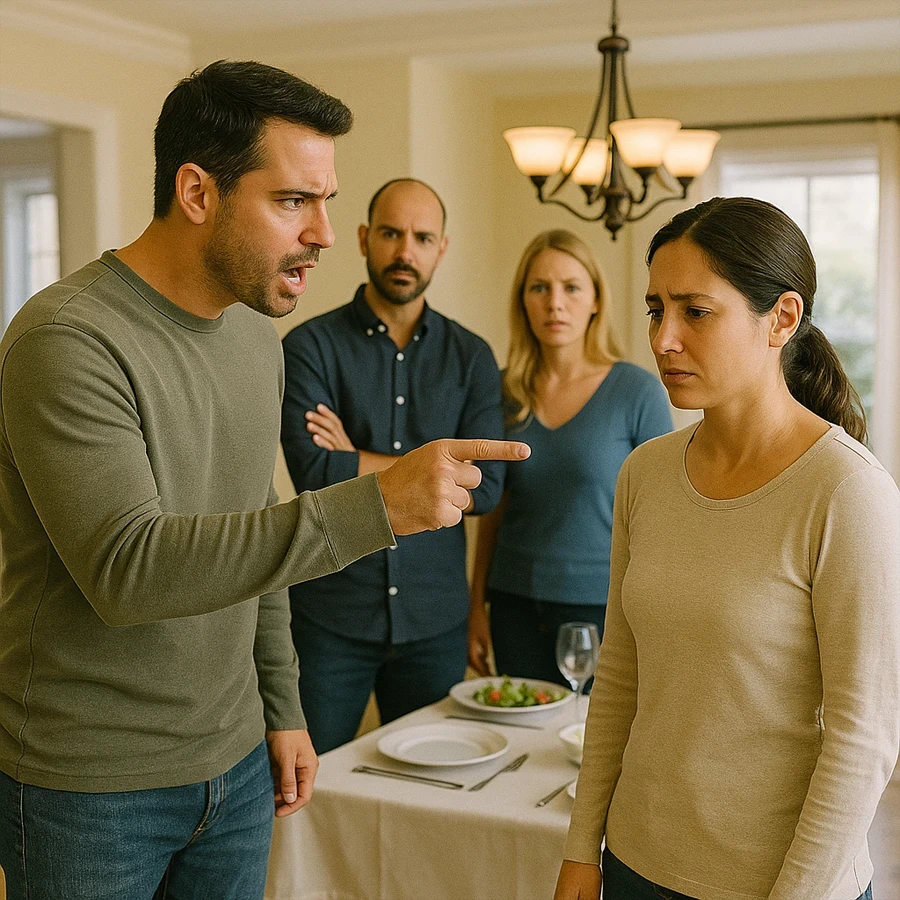
“Where have you been, you useless woman?! Everyone’s here and the table isn’t set!”
The words slammed into me before I even crossed the threshold into the dining room.
I was standing in the narrow hallway between the kitchen and the formal dining room, hands full of folded napkins and silverware, still wearing my apron. The smell of roasted chicken, garlic, and rosemary wrapped around me, but any sense of pride I’d had about the meal I’d just finished evaporated in an instant.
The room went silent.
My husband, Mark, stood at the head of the long mahogany table, one hand on the back of his chair, the other spread in a gesture of frustration. His sandy hair was neatly combed, his shirt crisp, his jaw clenched. He stared at me like I’d just ruined his entire life.
Around him sat our guests.
His parents, his younger sister Megan and her fiancé, his boss, and his boss’s wife. All dressed nicely, all holding glasses of wine, all watching me as if I were an actor who had missed her cue.
My face burned. My fingers tightened around the silverware so hard a fork slipped free and clattered to the hardwood floor.
“I was in the kitchen finishing the gravy,” I said quietly, bending to grab the fork. My voice sounded small, even to me.
Mark rolled his eyes. “The gravy? Emily, people have been sitting here for ten minutes. How hard is it to set a table on time?”
No one said anything.
I could feel their eyes: curious, pitying, uncomfortable. My heart pounded so loudly I wondered if anyone else could hear it. For a split second I imagined dropping everything, running out the front door, and not stopping until my lungs gave out.
Instead, I did what I always did.
“I’ll set it now,” I murmured.
I walked around the table, placing the napkins and silverware with practiced movements. Knife on the right, fork on the left, napkin folded just so. My hands had done this a thousand times. The first dinner party after we got married. His promotion celebration. Holiday meals. Birthday feasts. Each time, I told myself this was part of being a good partner, a good hostess, a good wife.
It felt different tonight.
Maybe it was the way the word “useless” had echoed in the room. Maybe it was the look on his boss’s wife’s face — a flash of disgust she quickly hid behind a polite sip of wine. Maybe it was the way my own chest clenched, as if my ribs were trying to protect something fragile inside.
I set the last fork, then straightened.
“There,” I said softly. “The table is set.”
Mark didn’t respond. He just pulled his chair out with more force than necessary.
“Finally,” he muttered.
Everyone shifted in their seats, pretending nothing had happened. His mother asked about the weather. His boss made a joke about traffic. Megan looked down at her phone, tapping the screen too quickly to be actually texting anyone.
“Emily?” Mark said, snapping his fingers once. “Can we get the food now?”
I forced my lips into a smile that felt like it belonged to someone else.
“Of course,” I said.
And then I turned and walked back to the kitchen with my spine as straight as I could make it, fighting the urge to cry over a pot of gravy.
The kitchen, at least, still felt like mine.
The counters were full — roasted chicken resting on a cutting board, tray of vegetables glistening with olive oil, a big bowl of salad, a pie cooling on the back counter. I had been up since six that morning cooking, chopping, seasoning, tasting. I’d gone over the menu with Mark twice before he approved it, reminding me how important this dinner was.
“My boss is old-fashioned,” he’d said, knotting his tie that afternoon. “He thinks the home reflects the spouse. You know how it is.”
Yes. I knew exactly how it was.
Standing there in the kitchen, I let the mask slip. My shoulders sagged. My chest felt tight, like someone had wrapped invisible bands around it and was slowly pulling.
“Useless woman,” I whispered to the empty room, testing the words in my own mouth.
They tasted bitter, like burned sugar.
I had heard a lot of things from Mark over the last five years — that I was “overreacting,” that I was “too sensitive,” that I should “relax more” or “try harder.” Those phrases had become the wallpaper of our marriage: always there, barely noticed, but slowly shaping the entire space we lived in.
“Useless” was new.
It sank into me in a way the others hadn’t, like a stone carried deep by a strong current. I thought of the grocery lists, the cleaned floors, the folded laundry, the budget spreadsheets, the lunches packed, the birthdays planned, the appointments kept, the late nights waiting up while he worked, the constant emotional patchwork I did to keep our days running smoothly.
If this was “useless,” I wondered what “useful” was supposed to look like.
I took a deep breath and picked up the serving platter. There was no time to fall apart. Not with guests in the next room.
But as I carried dish after dish to the dining table, something inside me had shifted. I could feel it, like a tiny crack in ice that you can’t see yet, but that changes the way it sounds when you step on it.
Dinner began like any formal dinner does: forced laughter, clinking cutlery, polite questions.
“The chicken is excellent, Emily,” Mark’s boss, Mr. Parker, said after a few bites. He was a tall man with silver hair and a calm, measured voice.
“Thank you,” I replied. “I’m glad you like it.”
His wife, Linda, who wore a tasteful string of pearls and a soft pink blouse, rested her fork on the edge of her plate and looked at me a little too intently.
“Do you do all the cooking yourself?” she asked.
“All the time,” Mark answered before I could speak. “She’s a natural. I tell her she doesn’t need to work when she can keep the house like this.”
He smiled, but there was something in it that made my stomach twist.
I used to work, before we moved for his job. Marketing assistant for a small local firm. Nothing fancy, but it was mine. A place where people sent me emails with “thank you” in them. A place where my name was on things I’d done, not just in the return address on our bills.
“I like cooking,” I said, forcing a light tone. “But I might go back to work once things settle down. I’ve been thinking about it.”
Mark’s hand tightened on his fork.
“Let’s not talk about that tonight,” he said, chuckling as if I’d just said something silly. “Right now we’re celebrating the team.”
Mr. Parker nodded. “Yes, Mark has done very well this quarter. We’re lucky to have him.”
Everyone lifted their glasses. I lifted mine too, the stem trembling slightly between my fingers.
“To the team,” I echoed.
“To Mark,” his mother added proudly.
We drank.
The conversation flowed around me like a river I had stepped out of. They talked about quarterly projections, new clients, the housing market, the latest sports game. I refilled glasses, passed dishes, smiled at polite intervals. It was like watching a movie I’d seen a hundred times but couldn’t remember why I liked.
At one point, Megan leaned toward me.
“Need any help in the kitchen?” she whispered.
It surprised me. She usually stayed out of family logistics.
“I’ve got it,” I whispered back. “Thanks, though.”
Her eyes flicked toward her brother, then back to me. There was something like sympathy there. Or maybe it was guilt. It was hard to tell in the dim chandelier light.
When dessert came, everyone praised the pie.
“Seriously, Em, you spoil us,” Mark said, leaning back in his chair. To anyone else, it would have sounded like a compliment.
To me, it just layered itself on top of everything else.
When the plates were empty and the coffee poured, Mark clapped his hands once.
“Alright,” he said. “Emily, can you grab the good whiskey from the cabinet in the den? The one my dad gave us.”
I didn’t move.
“Emily?” he said again, a hint of impatience returning.
Something inside me — that tiny crack under the surface — expanded.
“Mark,” I said quietly, “can you get it this time?”
The room froze for the second time that evening.
He blinked. “What?”
“I’ve been up since six cooking,” I said, my voice steady now. “I’m tired. You know where it is. Could you get the whiskey yourself?”
I kept my tone as calm and polite as I could. Not challenging. Just asking.
His jaw tightened.
“Everyone’s here,” he said tightly. “You’re the hostess.”
“Yes,” I replied. “And I’ve been hosting all night.”
My heart was racing. I could feel my own pulse in my throat. But there was a strange lightness, too, like the first breath after being underwater.
Mr. Parker cleared his throat.
“I can get it,” he offered, starting to rise. “You’ve done enough, Emily. Please, sit.”
His wife placed a hand on his arm. “Let me go with you,” she said, giving me a small, supportive smile before following him.
Mark stared at me, anger flickering behind his eyes.
“Can we talk in the kitchen?” he said.
I nodded. “Sure.”
I stood, my legs shaky but firm enough to walk. As I passed behind chairs and around the table, I heard Megan say something to her fiancé under her breath. I caught only a word — “unfair” — before the dining room door swung shut behind us.
In the kitchen, the smell of roasted garlic lingered. The sink was full of dishes I had promised myself I’d tackle tomorrow. It felt like neutral ground, but the tension that walked in with us settled over everything like steam.
Mark spun around to face me.
“What was that?” he demanded. “You’re embarrassing me in front of my boss.”
I folded my arms, suddenly very aware of the slight shake in my hands.
“What was what?” I asked.
“That little show out there,” he snapped. “You know how important tonight is for me. And you decide this is the time to start… making a point?”
His choice of words told me everything I needed to know: my asking him to get a bottle had become “making a point.”
I thought about his shout earlier — useless woman — booming through the dining room. I thought about how small I had felt, how I had swallowed it down to keep his evening perfect.
“What about earlier?” I asked quietly. “When you yelled at me in front of everyone. ‘Useless woman.’ What would you call that?”
He frowned and waved a hand as if swatting away a fly.
“Oh, come on, Emily. You know I didn’t mean it. I was just stressed. Everyone was seated, the table wasn’t ready, and—”
“And you chose to talk to me like that.” I didn’t raise my voice, but I didn’t soften it either. “In front of your family. In front of your boss. In front of everyone.”
“I said I was stressed,” he repeated, as if that explained everything. “Why are you making a big deal out of one phrase? You always do this. You blow things out of proportion.”
There it was. The old wallpaper.
I took a slow breath.
“Mark,” I said, “if I had stood in the middle of that dining room and shouted at you, ‘Where have you been, you useless man?’ in front of our guests, would that be ‘blowing things out of proportion’ too?”
He opened his mouth, then closed it.
“That’s different,” he muttered.
“How?” I asked.
“Because…” He ran a hand through his hair, searching for logic that would make sense out loud. “Because it just is. I’m under a lot of pressure at work. I’m responsible for everyone out there. For you.”
The word “responsible” landed heavily.
“You are not responsible for me,” I said. “We are supposed to be partners.”
“Then act like one!” he burst out. “Help me when I need you to. Don’t challenge me in front of my boss. Don’t pick tonight to suddenly become… difficult.”
The word “difficult” scratched something raw in me.
“Help you?” I repeated. “I have cooked this entire meal. Cleaned the house. Planned the menu. Checked everyone’s dietary needs. Smiled and served and made sure everyone is comfortable. I have done everything I can to help you tonight, Mark. The only thing you had to do was not humiliate me.”
He hesitated. For a tiny moment, doubt crossed his face. Then it hardened again.
“You’re overreacting,” he said, falling back on the familiar. “You always do this after events. You find something wrong with how I talked or what I said. It’s exhausting, Emily.”
I looked at him. Really looked at him.
The man I had married was in there somewhere. The man who brought me coffee every morning during our engagement. The man who had stayed up late helping me finish a work project once, just because I was stressed. The man who had cried at our wedding when he thought no one was looking.
I couldn’t see that man right now. I saw a man who believed that pressure gave him permission to be careless with my heart.
“It’s exhausting,” I said slowly, “to keep pretending this doesn’t hurt.”
We stood there in the cluttered kitchen, two people who shared a home but not the same reality.
“I’m going back in there,” he said finally. “We’ll talk about this later when you’ve calmed down.”
He turned toward the door.
Something in me snapped — not like something breaking, but like something finally coming loose that had been stuck for a long time.
“Wait,” I said.
He paused.
I took off my apron and folded it neatly, placing it on the counter like a small, symbolic offering.
“I’m not going to pretend this is normal,” I said. “Not tonight. Not anymore.”
He frowned. “What’s that supposed to mean?”
“It means,” I replied, “that I won’t keep playing the part you’ve written for me. The one where I smile and serve and ignore the way you talk to me when you’re stressed. The one where my feelings are ‘overreactions’ and your words are just ‘pressure.’”
“You’re making a scene again,” he said, his voice dropping, warning.
“There’s no scene,” I said. “Just… truth.”
I grabbed my phone from the counter and stuck it into my pocket.
“I’m going to step out for a bit,” I told him. “You can handle the rest of the evening. You’re very capable, remember? Everyone’s here. The table is set.”
He stared at me like I’d grown a second head.
“You can’t just leave,” he said. “Emily, don’t you dare walk out on this dinner. People will talk.”
“They probably already are,” I answered. “But this isn’t about them.”
His eyes widened as the realization sank in that I meant it.
“You walk out that door, Emily, and—”
“And what?” I asked quietly. “You’ll call me more names later? Tell me I’m overreacting again? We both know you’ll be charming out there. You’re very good at that. You don’t need me to pour whiskey to impress your boss.”
For a second, I thought he might reach out. Apologize. Say something that would stop this momentum.
Instead, he lifted his chin.
“You’re being dramatic,” he said coldly. “Go take a walk, then. I’ll explain to everyone that you weren’t feeling well.”
That hurt more than I expected. Not the lack of apology — I’d stopped expecting those years ago — but the ease with which he rewrote the story of what was happening, even to himself.
I nodded once.
“Alright,” I said. “If that’s the story you want to tell.”
And then I did something I had never done in the five years we’d been married.
I walked out of my own dinner.
The evening air hit me like a blessing.
It was cool and crisp, carrying the scent of wet leaves and distant grills from nearby yards. Our neighborhood was quiet, the kind of suburban street where every house looked slightly different but somehow the same, all neatly lined up like teeth in a perfect smile.
I walked down the front steps and onto the sidewalk without any idea of where I was going. I just knew I couldn’t stay inside that house a second longer pretending everything was fine.
At the end of the street, there was a small park with a couple of benches and a swing set. I’d walked by it a hundred times. Today, it felt like neutral ground — not his, not ours, just… there.
I sat on one of the benches and stared at the empty swings swaying gently in the breeze.
My phone buzzed. I pulled it out, half-expecting a text from Mark demanding I come back.
It wasn’t him.
It was Megan.
Are you okay?
I stared at the screen for a moment, surprised. Then my fingers moved.
I will be. Just needed air.
There was a pause. Then another message arrived.
I’m sorry about how he talked to you. That wasn’t right.
I swallowed hard.
Megan, I typed, has he always been like this? I mean… before me?
There was a longer pause this time.
My brother has always liked control, she wrote. But it’s gotten worse since the new job. Mom never called it out. Dad just avoided conflict. I guess we all did, in our own ways.
I thought of how his parents had looked away earlier, like if they pretended not to hear, it hadn’t happened.
You don’t have to stay in it, she added.
Tears blurred my vision.
Another message came through before I could respond.
If you need a place to go tonight, you can come over after everyone leaves. I mean it.
Kindness always hit me harder than cruelty. It was like my body knew how to brace for impact with harsh words, but gentleness slipped past my defenses.
Thank you, I replied. I don’t know what I’m doing yet. But… thanks.
I put my phone down and leaned back on the bench, looking up at the darkening sky. One by one, stars began to appear, faint at first, then more clearly.
My mind flipped through pages of memories like an anxious hand flipping through a book.
The first time Mark joked about how I “couldn’t do anything right” when I dropped a plate.
The time he told me I’d “never survive on my own” when I mentioned wanting to go back to work.
The way he would sigh and say, “Honestly, Em, what do you even do all day?” if the floor wasn’t spotless or the laundry wasn’t folded.
Each moment had felt small, forgivable, understandable in isolation. He was stressed. He had deadlines. He was in a mood. I was sensitive. I wanted too much.
But together, they formed a pattern. And tonight, that pattern had finally become impossible to ignore.
I wasn’t perfect. I could be forgetful. I could get anxious and avoid conflict. I had stayed quiet when I should have spoken up, laughed off comments that cut deeper than I admitted.
But I knew one thing with a clarity that surprised me: I was not useless.
I had built a home, held up a marriage, kept us afloat in ways he didn’t even see. I remembered birthdays and doctor’s appointments. I had sat by his side when his grandfather passed away, holding his hand in silence because he didn’t like to cry in front of others. I had kept a thousand small promises that made up our life.
Useless?
No.
Just unseen.
A car drove by, its headlights washing over the grass. Somewhere down the street a dog barked once and then stopped. The world kept moving, unaware that something inside me had shifted into a different position.
My phone buzzed again.
This time, it was Mark.
Where are you?
I stared at the message for a long moment.
I considered answering with our home address. With “at the park.” With “close enough to walk back.”
Instead, I realized his question was bigger than he knew.
Where was I?
Not just physically, but in the story of my own life.
For too long, I had been a supporting character in a narrative built around his goals, his stress, his success. Tonight, for the first time, I had stepped out of that script.
I’m safe, I wrote. I need some time to think.
Three dots appeared as he started typing. Then stopped. Then started again.
We have guests, he finally sent. This is not the time to be emotional. Please come back and we’ll sort this out later.
I felt something inside me cool and solidify.
He still didn’t understand.
I took a breath, feeling my feet firmly on the ground beneath me, and typed my answer.
We’ve sorted things out “later” for a long time. Nothing changes. I’m not coming back in there to pretend everything is fine. We’ll talk when the house is quiet.
I hit send before I could second-guess myself.
The dots appeared again. Disappeared. Reappeared.
Finally, the reply came.
Fine. Do what you want.
There it was. The permission I hadn’t realized I’d been waiting for.
Do what you want.
For once, I intended to.
An hour later, the house was quiet.
I knew because I waited under the streetlamp across from our home, watching cars pull away one by one. Mr. Parker and his wife were the last to leave. Linda turned to look back at the front door before getting into the car, her face thoughtful.
When their tail lights disappeared around the corner, I crossed the street and walked up the front path.
The porch light was still on. My key fit into the lock with the same soft click it always made. It struck me that everything about this house — the bricks, the door, the rug that said “Welcome” in cheerful letters — remained unchanged, while I felt like a different person than the one who had set the table a few hours earlier.
Mark was sitting at the dining room table when I walked in, his tie loosened, his sleeves rolled up. The table was cleared, except for two cups of coffee that had gone cold.
He looked up as I entered.
“You came back,” he said.
“Of course I came back,” I replied. “This is still my home. At least for now.”
He exhaled, like he’d been holding his breath.
The silence that followed felt fragile and heavy at the same time.
“I’m sorry,” he said finally.
The words hung there between us, unfamiliar.
“For what?” I asked, not to be cruel, but because I needed him to say it.
He rubbed his forehead.
“For what I said earlier,” he answered. “In front of everyone. I shouldn’t have called you useless. It was rude and… wrong.”
It wasn’t everything I wanted to hear, but it was more precise than the generic “sorry if you felt bad” apologies I’d grown used to.
“Thank you,” I said quietly. “I appreciate you saying that.”
He leaned back in his chair, looking tired.
“You really made things awkward tonight,” he said, almost like a reflex.
I felt my chest tighten, but this time I didn’t swallow it down.
“I left because I needed to show myself that I could,” I said. “Because I needed to feel that staying is a choice, not the only option.”
He frowned. “Of course it’s a choice. You’re not trapped.”
“Aren’t I?” I asked gently. “You’ve told me before I’d never survive on my own. That I’d fall apart without you. That you know what’s best for us. Do you think that makes me feel free?”
He looked away.
“I was… exaggerating,” he muttered.
“Maybe,” I said. “But words add up, Mark. They become the story we tell ourselves. The story I tell myself about who I am. And lately, that story hasn’t been kind.”
I pulled out a chair across from him and sat down.
“I went to the park,” I said. “I sat on a bench and thought about every time you’ve dismissed my feelings, every time you’ve used words like ‘overreacting’ or ‘dramatic’ or ‘too sensitive.’ Every time you made a joke at my expense in front of your friends and said I needed to learn to take it.”
He opened his mouth, but I held up a hand.
“Just let me finish,” I said.
He closed it again.
“I realized tonight that I’ve been shrinking myself to fit your comfort,” I continued. “Taking up less space, speaking softer, letting things slide, all so that you wouldn’t feel ‘attacked’ when I brought up something that hurt me.”
He looked genuinely troubled, which was new.
“I didn’t know you felt that way,” he said.
“I told you,” I replied. “Maybe not with this level of clarity. Maybe not all at once. But I’ve told you when things hurt. And you told me I was making a big deal out of nothing. Enough times that I started wondering if I was.”
He shifted in his seat, his gaze flicking to the empty doorway, as if someone might walk through and rescue him from this conversation.
“What do you want, Emily?” he asked finally. “Just tell me what you want me to do.”
It was tempting to give him a list. To say: “Never speak to me like that again. Go to counseling. Share the housework. Listen without defensiveness. Ask how I am without making it about you. Apologize when you hurt me without excuses.”
But I had learned that change didn’t happen because someone told you to act differently for a night.
“I want to feel safe in my own home,” I said instead. “Safe to make a mistake without being insulted. Safe to voice hurt without being told I’m too emotional. Safe to be a partner, not a servant you present when it’s convenient.”
He stared at me for a long time.
“I didn’t realize you felt like a servant,” he said softly.
“Well,” I replied, “tonight I felt like a servant who didn’t work fast enough.”
He winced.
“I messed up,” he admitted. “Big time.”
He rubbed his face with both hands, then looked at me again.
“I don’t want to lose you,” he said. “I know I’m not easy. Work has been… intense. I know that doesn’t excuse anything, but it’s made me… harder. I take things out on you because you’re there. Because you’ve always been there.”
There was a sad kind of truth in that.
“I don’t want to be the person you unload on because you don’t know where else to put your stress,” I answered. “I can support you. I want to. But not at the cost of my dignity.”
We sat in silence for a moment, listening to the faint hum of the refrigerator.
“I’ll go to counseling,” he said suddenly. “If you want. For me. For us. I’ll try to… unlearn whatever it is I’ve been doing. I don’t want you to feel small, Em.”
I searched his face for insincerity and didn’t find it. But I also knew something important: a willingness to try was a start, not a solution.
“I’m willing to try too,” I said. “But I need you to understand something.”
He nodded warily. “Okay.”
“I’m not promising anything,” I continued. “Not promising that counseling will magically fix everything. Not promising that I’ll stay no matter what. I’m promising to show up honestly, say what I feel, and listen. But if I keep feeling like this—” I gestured between us— “I will leave. Not as a threat. As a boundary.”
The word seemed to hang in the air: boundary.
I’d read about them in articles shared by friends, in late-night scrolling sessions when I couldn’t sleep. They always sounded abstract, like something other people had. Tonight, they felt like the only thing keeping me from slipping back into old patterns.
He nodded slowly.
“I don’t like hearing that,” he admitted. “The part about you maybe leaving. But I guess… it’s fair. I haven’t exactly earned unconditional trust lately.”
He looked smaller in that moment, less like the man who barked orders and more like the young guy who once asked me, nervously, if I thought he was good enough for me.
“I’ll call someone tomorrow,” he said. “A counselor. We can go together. If you want.”
“I want,” I said.
He exhaled, long and shaky.
“Okay.”
We didn’t hug. We didn’t suddenly fall into each other’s arms. There was no dramatic music swelling in the background. There was just the two of us, sitting at a table that had seen a hundred meals and a thousand unspoken tensions, quietly acknowledging that something had broken that could not be ignored.
Whether it would be repaired or replaced was a question for another day.
Six months later, I set a table again.
It was the same mahogany dining table, but the guest list was smaller: just me, Mark, and Megan, who had come over with a tray of store-bought brownies and a bottle of sparkling water.
We’d been in counseling for four months by then.
It hadn’t been easy. The first few sessions, Mark spent most of the time explaining how stressed he was and how much pressure he was under. Our therapist, a kind but firm woman named Dr. Chen, listened patiently and then gently asked him the same question, over and over, in different ways:
“And how do you think that has felt for Emily?”
Sometimes he answered honestly. Sometimes he stumbled. Sometimes he deflected, and she would bring him back, calmly, like a lighthouse rotating its beam until it found him again.
For me, therapy became a place to reconnect with my own voice. To say out loud, without interruption, “That hurt me.” To hear someone respond, “That makes sense,” instead of “You’re overreacting.”
We learned words like “respect,” “emotional safety,” and “repair.” We talked about patterns passed down from his parents, about the stories I told myself about what a “good wife” was supposed to tolerate.
We fought sometimes, more openly than before. But we also apologized more genuinely. Not the rushed, “sorry, okay?” kind of apology, but the slower, “I see how I hurt you and I will work on this” kind.
It wasn’t a miracle. There were days I left sessions feeling hopeful, and days I sat in my car afterward crying because change felt so slow.
But something was different.
Mark stopped using words like “overreacting” and “dramatic.” When he slipped, our therapist would gently name it the next session, and we’d unpack it together. He started catching himself, rephrasing in real time.
“Can I say that again?” he’d ask sometimes, mid-argument.
And slowly, my shoulders stopped tensing every time he opened his mouth in front of others.
Tonight, as I put out plates and silverware, I wasn’t doing it alone.
Mark stood beside me, carrying the stack of plates, asking, “Forks on the left, right?” with a sheepish smile.
“Right,” I said, smiling back.
We traded glances over the tablecloth. There was a history between us now we both saw clearly — the good and the bad. The night of the “useless woman” comment had become a reference point, something we talked about openly in therapy and, occasionally, carefully, on our own.
“I still think about that night,” he had told me recently, voice quiet. “I hate that I said that to you. I hate that it took you walking out for me to see how far I’d gone.”
“And I hate that I waited that long to walk out,” I had replied. “But I’m glad I finally did.”
It had become less a wound and more a scar — sensitive, yes, but also a reminder of where we had chosen to turn instead of continuing straight toward a cliff.
Now, Megan sat at the table, watching us with a small smile.
“You two are different,” she said suddenly, as I set down the salad.
“How so?” I asked, curious.
“You listen more,” she said simply. “Both of you. And Mark hasn’t raised his voice once since I got here. That’s new.”
Mark chuckled, a little embarrassed.
“I have a very observant sister,” he said.
“She cares,” I replied, giving her a grateful look. “She texted me that night, you know.”
He nodded. “I know. She yelled at me later.”
“Good,” I said.
We ate. We talked. We laughed. The table felt less like a stage and more like a shared space.
At one point, I knocked over my water glass, sending a splash across the table.
“Oh!” I gasped, grabbing a napkin.
Without missing a beat, Mark said, “It’s okay, I’ve got it,” and jumped up to grab a towel from the kitchen. He didn’t sigh. He didn’t roll his eyes. He didn’t make a joke at my expense.
He just cleaned it up with me, side by side. A simple act, but it made something warm unfold in my chest.
Later, after Megan left and the dishes were rinsed, I stepped out into the backyard. The sky was clear, the air cool. Mark joined me a minute later, standing beside me on the small patio.
“Can I ask you something?” he said.
“Sure.”
“If I… if I mess up again,” he began, “not like I used to, but… you know, if I say something thoughtless or forget to listen—”
“You will,” I said gently. “We both will. We’re human.”
He smiled faintly. “Right. But if I do… will you tell me right away? Before it builds up? I don’t ever want to be surprised again by how much I’ve hurt you without realizing.”
I thought about it and nodded.
“Yes,” I said. “And I expect the same from you. If I dismiss your stress or forget to ask how you are, I want you to tell me. Just… not by shouting across a table.”
He winced. “Deal.”
We stood there in comfortable silence for a few moments, the sound of distant traffic humming like a soft background track.
“Em?” he said quietly.
“Yeah?”
“Thank you,” he said. “For leaving that night.”
It wasn’t something I expected to hear.
“For leaving?” I repeated.
“Yeah,” he said. “If you hadn’t walked out, I probably would have kept telling myself everything was fine. That you were just being sensitive. That I didn’t have to change.”
He shook his head slightly.
“I’m not proud of that,” he added. “But it’s true.”
I looked at him, at this man who had once been so sure he was always right, now standing here admitting that his wife’s boundary had saved their marriage more than her silence ever could.
“I’m glad I left too,” I said. “It reminded me that I had a choice.”
He reached for my hand, slowly, giving me time to refuse. I didn’t. Our fingers laced together.
The night was quiet. The table inside was set for three, not for show, not for promotion, but for connection.
I knew we weren’t perfect. I knew there would be more hard conversations, more late-night sessions in that small therapy office, more moments when old habits tried to creep back in.
But I also knew this: I would never again believe I was useless.
That night in the dining room had been the worst kind of mirror, reflecting back not who I was, but how little of me was being seen. Walking out had been the moment I chose to see myself clearly instead.
Whether our marriage lasted another year or a lifetime, I had already changed something essential: the way I would allow myself to be treated by the person who said he loved me.
And that, I realized, was the beginning of a story where I was no longer a background character.
I was the one who stayed, who left, who chose, who spoke.
I was the one who set the table — not just with plates and forks, but with expectations for how we would treat each other from now on.
And at last, sitting at that same table months later, I finally felt like I belonged at the head of my own story.
THE END